Acorn
Robot / hardware buildPrecision farming rover with separate software, electronics and mechanical sources; the documented Docker simulation substitutes fake sensor data and is not evidence of field performance. [1] [5] [9] [11]
Build & first use →Official website
- For
- Robotics developers able to reconcile experimental software with separately versioned hardware [1]
- Cost
- No current cost or bill of materials established yet.
- Source rights
- Named licenses are documented by part. Review licenses
- Unknowns
- tools not fully established. Review gaps
Source researched · Not tested by us
Sources checked · Research details

Licenses & related hardware
- License
- CERN-OHL-P-2.0, Apache-2.0 · Details by part
Overview
Acorn's main repository contains software for the Twisted Fields precision farming rover. Its mechanical and electronics sources live separately. This review preserved those repository snapshots and examined the documented Docker simulation, without treating the snapshots as a tested hardware/software configuration. [1] [5] [9] [11]
Is this for you?
- Known limitations
- Simulation stubs hardware and uses fake sensor data
- Mechanical archive only points to externally hosted Onshape models
- Separate hardware and software snapshots are not a tested configuration pair
- Third-party steering references and CAD library models have separate or unresolved rights
What you need
Hardware & parts
Assembly & first use
Cost
No current, complete configuration-specific build cost has been established for this profile.
3D preview
Preview not available yet. CAD files were identified. A configuration-matched assembly and its file-level reuse scope have not yet been verified for this preview.
Model sources
CAD files were identified. A configuration-matched assembly and its file-level reuse scope have not yet been verified for this preview.
Project notes
What the simulation actually exercises
The simulation guide describes two containers: the normal server and a simulated vehicle. It explicitly says the vehicle stubs out hardware and returns fake sensor data. That can support navigation-software development and integration testing, but it does not validate steering hardware, GNSS accuracy or behavior in a field. [5] [6]
The launch scripts are designed for Linux and require Docker and Docker Compose, with host ports including port 80 available. The guide calls the route early alpha quality. It describes loading a path, clearing an autonomy hold and activating the simulated vehicle, with separate main and motor processes visible through tmux. No containers or vehicle code were run here. [5]
The simulation configuration extends the vehicle configuration, whose settings include privileged access, host networking and device mounts. That makes host configuration part of the documented environment; a source checkout alone is not a ready-to-run or isolated test installation. Those files were read as source, not executed. [6] [7]
Mechanical and board archives have different contents
The mechanical repository preserved at b38484cd4b082d9f2225f9568dff14d85ba919be contains an Onshape link and a license, rather than exported CAD payloads. Its permissive CERN Open Hardware Licence describes source rights, but this review did not export or validate the linked mechanical design. [9] [10]
The electronics snapshot contains a CM4 robot-board directory with KiCad schematic and PCB source plus Gerber outputs. That is stronger evidence of preserved board artifacts, but it still does not establish a complete manufactured rover, a matched controller firmware release or a current delivered BOM cost. [11] [14]
What we checked
Source research only; no installation, physical build or performance test performed. No affiliate links added.
Not yet established
- Requirements: tools
- A step-by-step setup summary
Updates
- Upstream last updated
- Jul 6, 2024 [2]
- Latest release
- Not established
- Profile updated
- Oct 25, 2026
- Sources last checked
- Oct 1, 2026
- Next review
- Oct 31, 2026
- Reviewed revision
- 9f4010dd37d95e8d9d8e61dd96ab94bd02b153b0 (commit snapshot; no published stable release found) · combined hardware and software repository
Source files and licenses
Available project sources support research coverage; complete build and commercial qualification remain separate.
| Layer | Availability / license |
|---|---|
| mechanical design | available · CERN-OHL-P-2.0 Official mechanical repository links Onshape and supplies permissive CERN OHL text. That archive has only README/license; actual CAD payload was not exported or preserved. [9] [10] |
| electronics | available · CERN-OHL-P-2.0 Selected CM4 board source and Gerbers preserved under board-level grant. Bundled SnapEDA library models have separate terms, so this is not an unqualified license for every archive file. [11] [12] [13] [14] |
| firmware | not found · License not fully assessed Complete matched motor-controller firmware not preserved by this review; electronics files alone do not establish a bootable controller stack. [1] [11] [14] |
| software | available · Apache-2.0 Project source under Apache-2.0; bundled external reference documents and dependencies retain separate terms. [1] [3] [5] |
| documentation | available · Apache-2.0 Project documentation; steering-reference PDFs explicitly have unknown licensing and are excluded from a blanket reuse claim. [1] [3] [5] [8] |
Selected simulation and source-architecture review does not assess a learned policy or training dataset.
Check licenses at the component level
The main project source uses Apache-2.0. A steering-reference directory, however, explicitly says the license of its copied external PDFs is unknown. The catalog does not apply the project license to those third-party documents. [3] [8]
The selected CM4 board carries CERN-OHL-P terms. Its bundled SnapEDA symbol/footprint models carry separate terms that distinguish integrated circuit designs from redistribution of individual library models. The mechanical and board grants should therefore not be read as one blanket permission covering every file in every repository. [10] [12] [13]
The preserved sources support a more precise starting point for development: identify the simulation environment, preserve actual design payloads, and then reconcile hardware and firmware revisions. No compilation, assembly, motion test or agricultural field trial was performed by this review. [5] [9] [11] [14]
References
Each source links to the exact revision we read. “Used for” shows where this page relies on it.
- S001 Twisted-Fields/acorn-precision-farming-rover: README.md
Revision, date & where cited
github.com · revision
9f4010d· Accessed Oct 1, 2026
Used for: Overview, Hardware & parts, Assembly & first use, Source files and licenses - S002 Twisted-Fields/acorn-precision-farming-rover: commit 9f4010d
- S003 Twisted-Fields/acorn-precision-farming-rover: LICENSE
Revision, date & where cited
github.com · revision
9f4010d· Accessed Oct 1, 2026
Used for: Source files and licenses - S004 Twisted-Fields/acorn-precision-farming-rover: files
Revision, date & where cited
github.com · revision
9f4010d· archive file inventory · Accessed Oct 1, 2026 - S005 Acorn SIMULATION.md
Revision, date & where cited
github.com · revision
9f4010d· Accessed Oct 1, 2026
Used for: Overview, Is this for you?, What you need, What the simulation actually exercises and 1 more - S006 Acorn docker-compose-simulation.yml
Revision, date & where cited
github.com · revision
9f4010d· Accessed Oct 1, 2026
Used for: What you need, What the simulation actually exercises - S007 Acorn docker-compose-vehicle.yml
Revision, date & where cited
github.com · revision
9f4010d· Accessed Oct 1, 2026
Used for: What you need, What the simulation actually exercises - S008 Acorn docs/steering/README.md
Revision, date & where cited
github.com · revision
9f4010d· Accessed Oct 1, 2026
Used for: Is this for you?, Source files and licenses - S009 Acorn acorn-mechanical-designs README.md
Revision, date & where cited
github.com · revision
b38484c· Accessed Oct 1, 2026
Used for: Overview, Is this for you?, Hardware & parts, Mechanical and board archives have different contents and 1 more - S010 Acorn acorn-mechanical-designs LICENSE
Revision, date & where cited
github.com · revision
b38484c· Accessed Oct 1, 2026
Used for: Mechanical and board archives have different contents, Source files and licenses - S011 Acorn acorn-robot-electronics README.md
Revision, date & where cited
github.com · revision
ff52caf· Accessed Oct 1, 2026
Used for: Overview, What you need, Hardware & parts, Mechanical and board archives have different contents and 1 more - S012 Acorn acorn-robot-electronics cm4_robot_board/LICENSE
Revision, date & where cited
github.com · revision
ff52caf· Accessed Oct 1, 2026
Used for: Source files and licenses - S013 Acorn acorn-robot-electronics cm4_robot_board/parts/License.txt
Revision, date & where cited
github.com · revision
ff52caf· Accessed Oct 1, 2026
Used for: Is this for you?, Source files and licenses - S014 CM4 board fabrication file inventory
Revision, date & where cited
github.com · revision
ff52caf· selected archive inventory · Accessed Oct 1, 2026
Used for: What you need, Mechanical and board archives have different contents, Source files and licenses - S015 Upstream image and reuse attribution
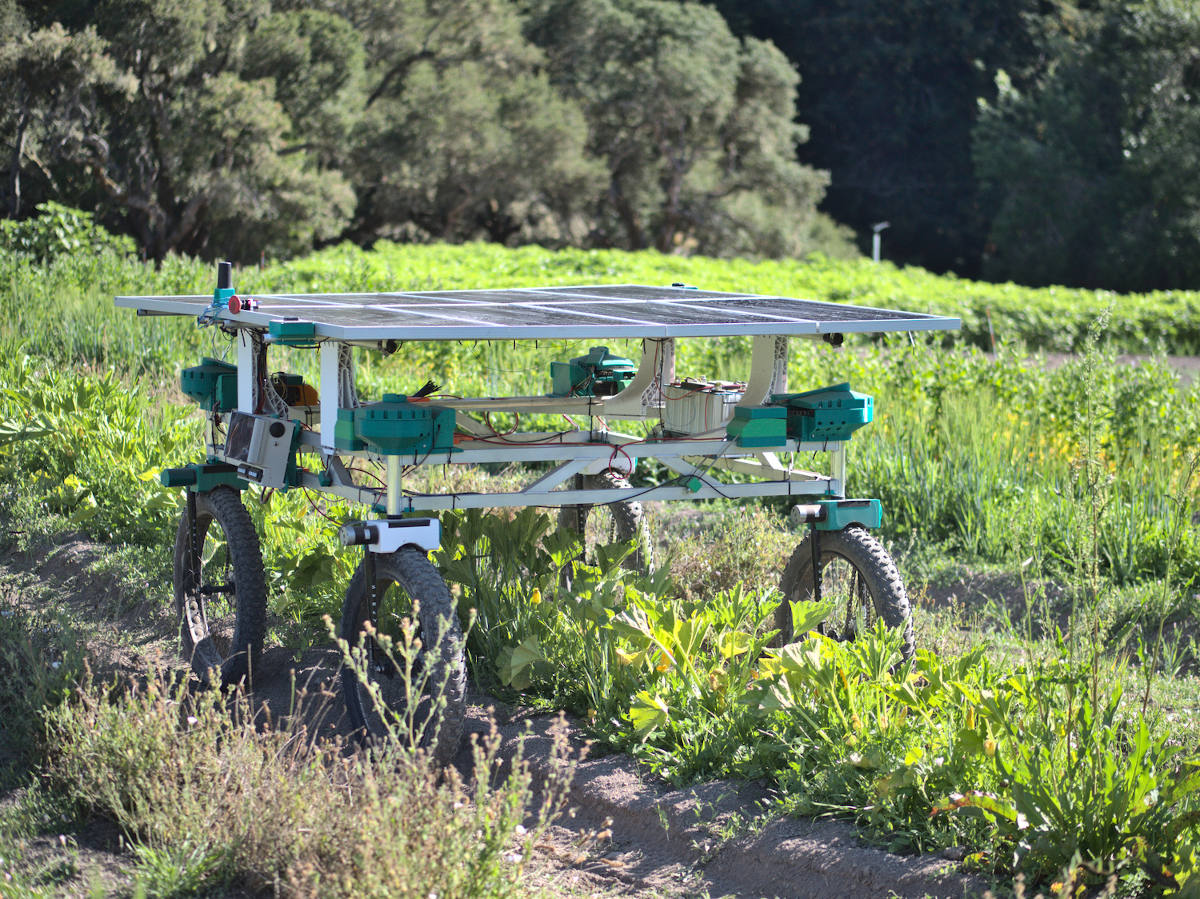
Media-only review: Upstream photograph of the Acorn farming rover in a field; this is not a build tested by us. Reuse basis: Apache-2.0; inspected LICENSE and the pinned file inventory for nearer notices. Original image unchanged; displayed responsively. This does not refresh technical or cost evidence.Revision, date & where cited
Twisted Fields contributors · github.com · revision
9f4010d· Image SHA-256 47ff1df84190ec1b8ee44f53672ec661e563884a63cd35aaf5563740b7c88146; repository · Accessed Oct 25, 2026
Correction guidance · Discussion is not enabled · Profile format 0.6.0-draft.1
Change history
2026-10-25 — Added an attributed upstream image with linked reuse terms; technical evidence dates unchanged.