Acromonk
Robot / hardware buildUnderactuated bar-swinging research robot with one QDD actuator, passive hooks and simulation/control sources; requires a ladder test rig, and the reviewed hardware script conflicts with its guide. [1]
Build & first use →Official websiteBill of materials
- For
- Research labs with experience in dynamic robot control and motor commissioning [1]
- Cost
- No current cost yet. Upstream bill of materials [5]
- Source rights
- Some licenses are unresolved. Review licenses
- Unknowns
- host computer, tools not fully established. Review gaps
Source researched · Not tested by us
Sources checked · Research details

Licenses & related hardware
- License
- BSD-3-Clause · license not fully assessed for model weights, datasets · Details by part
Overview
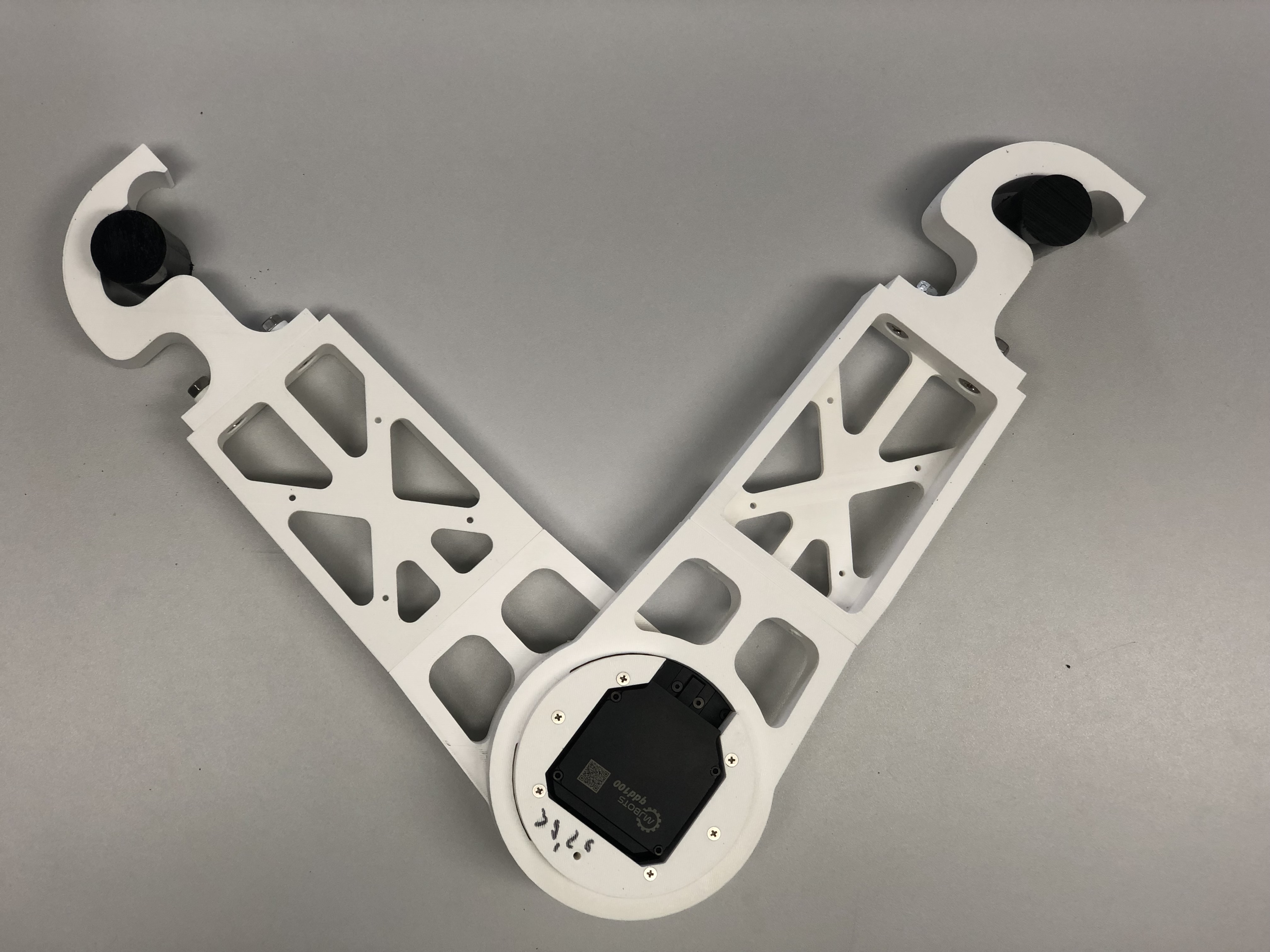
AcroMonk is a research robot that swings between horizontal ladder bars using one quasi-direct-drive actuator and passive grippers. The project combines a printed mechanical assembly, a Raspberry Pi control stack and simulation tools for generating and stabilizing motion. Its useful starting question is how to control an underactuated swing; the project is not a general-purpose walking robot or a ready-to-run household kit. [1] [6]
Is this for you?
- Known limitations
- Physical testing requires a ladder-bar cage and controlled operating area
- The BOM mixes EUR-labelled prices with USD components and excludes printing/shipping
- Simulation uses a historical mujoco-py stack
- Motor zero and IMU orientation depend on the initial configuration
- Reviewed robust-forward script disables kickback, swing and catch, stubs attachment detection, and calls positioning before its Start prompt
3D preview
AcroMonk CAD assembly. Assembly geometry from the upstream STEP. Purchased components are represented; their manufacturing sources and physical fit are not established by this preview.
The 3D preview loads after the page.
Drag to orbit · Scroll or pinch to zoom · Right-drag to pan. Use the view buttons for front, side and top views. The tree shows names supplied by the source; unnamed bodies remain labeled as such.
Download original STEP (gzip) · File checksums and provenance
Separate bodies can be inspected in the model tree. Explode is a viewing aid, not an assembly sequence.
Model sources
The preview uses the linked original design. Source grouping is retained where present; the caption identifies whether this is an assembly or one component.
Source, license and scale
Source: dfki-ric-underactuated-lab contributors, revision 7cbc5f755ab5578c4d7f1ba7edaa99d72bc3c050. Original and preview: BSD-3-Clause. Preview conversion by Open Source Robotics; original file unchanged. Preview coordinates are centered and rounded to six decimal places. STEP preview triangulated in millimetres. No physical part tested.
Viewer: three-cad-viewer 5.0.7 (MIT license). Confirm scale and manufacturing settings before printing.
What you need
- Operating system
- Upstream reports simulation software tested on Ubuntu 20.04 and 22.04
Upstream statement only; current compatibility not tested here.
Hardware & parts
Assembly & first use
- Inspect the simulation model and historical dependency versions
- Generate or select an atomic trajectory and evaluate stabilization in simulation
- Assemble the matched robot and ladder-bar test rig
- Verify emergency stop, motor/bus IDs, hanging zero and INIT_CONF before hardware commissioning
Editorial research sequence; not an executable commissioning checklist or tested procedure.
Cost
No current, complete configuration-specific build cost has been established for this profile.
Project notes
Build the test environment into the plan
The hardware guide describes six unique printed structural parts, a Raspberry Pi 4 Model B, mjbots pi3hat, a qdd100 beta 3 servo and a 6S 1200 mAh LiPo battery. The archive includes an assembly STEP file, and the guide supplies a wiring diagram and a remote emergency-stop circuit. The ladder-bar rig is part of the experiment: upstream calls for a cage, access to the stop and at least one metre of separation during operation. Those requirements matter when deciding whether a lab can accommodate the platform. [1] [5] [6] [13]
The BOM reports an estimated total of 950–1000 under a Germany/euro heading, but two major components are explicitly priced in dollars. It also excludes shipping and printing. Without a stated currency conversion and a current configuration-specific quote, that figure cannot serve as a verified delivered-build budget. This catalog leaves the current complete cost unknown. [5]
Begin with the historical simulation environment
The simulation guide reports testing on Ubuntu 20.04 and 22.04. It uses Drake for trajectory work, while the reinforcement-learning path uses MuJoCo 2.1 through mujoco-py; the requirements also name older NumPy, SciPy and Stable Baselines versions. This is a specific historical environment, not evidence that installing the newest Drake or native MuJoCo package will reproduce it. No dependency installation was performed for this review. [7] [9]
The documented trajectory workflow chooses an atomic behavior, generates a solution with direct collocation and saves trajectories and hyperparameters. A separate stabilization script evaluates TVLQR or PID gains and writes closed-loop outputs. That provides a useful first research task before attempting motion on hardware. The repository also contains a trained-controller archive, but its contents and training provenance were not validated here. [7] [13]
Initial configuration changes the interpretation of motion
The physical-system guide assumes execution on the Raspberry Pi and has its own moteus and moteus-pi3hat dependencies. Motor ID, CAN bus, trajectory and recovery files are configurable. The motor zero is established when power is applied with the arm hanging at the documented zero angle. INIT_CONF changes whether the IMU arm swings or stays attached and changes the motor-axis sign convention. These are commissioning inputs, not optional presentation settings. [8] [10]
The Makefile passes controller and configuration arguments to the hardware script, and the script reads the requested brachiation count from the NBRACH environment variable, defaulting to one. The saved script does not implement the guide’s complete execution path: its kickback, swing and catch wrappers return early, and generate_aa returns a constant instead of checking arm attachment. It also calls go_to_pos before displaying the “Start?” prompt. A lab must reconcile the guide with a matching implementation before planning hardware reproduction; removing those returns alone is not a validated repair. This review did not energize an actuator or execute the script. [8] [11] [12]
What the archive establishes
The project declares its work BSD-3-Clause and explicitly separates third-party software terms. CAD, integration documentation and control code are present. That does not establish the licenses of every purchased board or external firmware dependency, nor the provenance of the supplied trained-controller file. The guide/code conflict is an observed limitation of this saved revision, separate from the absence of testing. Manufacturing quality, simulation fidelity and repeated brachiation have not been tested by this publication. [1] [3] [6] [8] [12] [13]
What we checked
Source research only; no installation, physical build or performance test performed. No affiliate links added.
Not yet established
- Requirements: host computer, tools
Updates
Source files and licenses
Available project sources support research coverage; complete build and commercial qualification remain separate.
| Layer | Availability / license |
|---|---|
| mechanical design | available · BSD-3-Clause Repository work is declared BSD-3-Clause; third-party parts and packages retain separate terms. [1] [3] [13] |
| electronics | available · BSD-3-Clause Integration wiring is documented; Raspberry Pi, pi3hat and actuator board designs are external components, not completely supplied here. [3] [6] |
| firmware | not found · License not fully assessed Actuator firmware is an external moteus dependency; complete matched firmware sources/settings not established in this archive. [1] [6] [13] |
| software | available · BSD-3-Clause Repository work is declared BSD-3-Clause; third-party parts and packages retain separate terms. [1] [3] [13] |
| model weights | available · License not fully assessed A trained-controller archive is present; its contents, training provenance and weight-specific reuse terms were not verified. [13] |
| datasets | available · License not fully assessed Trajectory CSVs and hyperparameters available; not a verified complete training dataset or independently reproduced result. [7] [13] |
| documentation | available · BSD-3-Clause Repository work is declared BSD-3-Clause; third-party parts and packages retain separate terms. [1] [3] [13] |
References
Each source links to the exact revision we read. “Used for” shows where this page relies on it.
- S001 dfki-ric-underactuated-lab/acromonk: README.md
Revision, date & where cited
github.com · revision
7cbc5f7· Accessed Oct 1, 2026
Used for: Overview, Is this for you?, Hardware & parts, Assembly & first use and 3 more - S002 dfki-ric-underactuated-lab/acromonk: commit 7cbc5f7
- S003 dfki-ric-underactuated-lab/acromonk: LICENSE
Revision, date & where cited
github.com · revision
7cbc5f7· Accessed Oct 1, 2026
Used for: What the archive establishes, Source files and licenses - S004 dfki-ric-underactuated-lab/acromonk: files
Revision, date & where cited
github.com · revision
7cbc5f7· archive file inventory · Accessed Oct 1, 2026 - S005 AcroMonk: hardware/bills-of-materials.md
Revision, date & where cited
github.com · revision
7cbc5f7· Accessed Oct 1, 2026
Used for: Is this for you?, Hardware & parts, Build the test environment into the plan - S006 AcroMonk: hardware/testbench-description.md
Revision, date & where cited
github.com · revision
7cbc5f7· Accessed Oct 1, 2026
Used for: Overview, Hardware & parts, Assembly & first use, Build the test environment into the plan and 2 more - S007 AcroMonk: software/python/simulation/README.md
Revision, date & where cited
github.com · revision
7cbc5f7· Accessed Oct 1, 2026
Used for: Is this for you?, What you need, Assembly & first use, Begin with the historical simulation environment and 1 more - S008 AcroMonk: software/python/real_system/README.md
Revision, date & where cited
github.com · revision
7cbc5f7· Accessed Oct 1, 2026
Used for: Is this for you?, Assembly & first use, Initial configuration changes the interpretation of motion, What the archive establishes - S009 AcroMonk: software/python/simulation/requirements.txt
Revision, date & where cited
github.com · revision
7cbc5f7· Accessed Oct 1, 2026
Used for: What you need, Begin with the historical simulation environment - S010 AcroMonk: software/python/real_system/requirements.txt
Revision, date & where cited
github.com · revision
7cbc5f7· Accessed Oct 1, 2026
Used for: What you need, Initial configuration changes the interpretation of motion - S011 AcroMonk: software/python/real_system/Makefile
Revision, date & where cited
github.com · revision
7cbc5f7· Accessed Oct 1, 2026
Used for: Initial configuration changes the interpretation of motion - S012 AcroMonk: software/python/real_system/robust_forward_brachiation.py
Revision, date & where cited
github.com · revision
7cbc5f7· Accessed Oct 1, 2026
Used for: Is this for you?, Initial configuration changes the interpretation of motion, What the archive establishes - S013 Pinned AcroMonk artifact inventory
Revision, date & where cited
github.com · revision
7cbc5f7· Complete preserved archive filenames; not a manufacturing test · Accessed Oct 1, 2026
Used for: Assembly & first use, Build the test environment into the plan, Begin with the historical simulation environment, What the archive establishes and 1 more - S014 Upstream image and reuse attribution
Media-only review: Upstream photograph of the AcroMonk brachiating robot assembly. Reuse basis: BSD-3-Clause; inspected LICENSE and the pinned file inventory for nearer notices. Original image unchanged; displayed responsively. This does not refresh technical or cost evidence.Revision, date & where cited
DFKI RIC Underactuated Robotics Lab and AcroMonk contributors · github.com · revision
7cbc5f7· Image SHA-256 1ba0cf28d0601ee1488d5ff1a0b3dde6f57c7d071bd0cfa4d62ae40cea5cb386; repository · Accessed Oct 25, 2026
Correction guidance · Discussion is not enabled · Profile format 0.6.0-draft.1
Change history
2026-10-25 — Added an attributed upstream image with linked reuse terms; technical evidence dates unchanged.