CogniFly
Robot / hardware buildSub-250 g collision-resilient quadcopter with a bamboo or carbon-rod frame joined by printed TPU parts, an INAV flight controller and a Raspberry Pi Zero W controlled through the MIT-licensed cognifly-python library; no license file was identified for the frame files. [3] [6] [8]
Build & first use →Official websiteUpstream build guideBill of materials
- For
- Researchers and educators able to 3D print TPU and PLA parts, solder flight electronics and configure INAV and a Raspberry Pi [3] [5] [8]
- Cost
- CAD 407.90 upstream parts estimate [3] [4] · checked Oct 5, 2026 · DetailsNot included: shipping except the separately shipped Raspberry Pi, taxes not stated and tools including 3D printer and soldering iron and more.
- Source rights
- Some licenses are unresolved. Review licenses
- Unknowns
- operating system not fully established. Review gaps
Source researched · Not tested by us
Sources checked · Research details
Licenses & related hardware
- Ecosystem
- Raspberry Pi
- License
- MIT · no license identified for mechanical design · license not fully assessed for firmware, documentation · Details by part
Overview
CogniFly, from The CogniFly Project started at MISTLab, is a quadcopter built to keep flying after collisions: 3 mm wooden sticks or carbon rods join flexible printed TPU parts that absorb impacts. A Raspberry Pi Zero W acts as the pilot, commanding an INAV flight controller over a serial link. The website ties the sub-250 g target to Canadian rules that, in March 2019, harshly restricted drones above 250 g. [3] [8]
It suits researchers and educators who want a Python-scriptable onboard computer and can print TPU and PLA parts, solder and configure INAV. [3] [5] [6]
Is this for you?
- Use cases
- Autonomous flight experiments
- Python-scripted drone control
Derived from stated purpose and control library.
- Known limitations
- No license file identified for frame/STL files
- Two documented configurations (paper vs Version 2) use different motors, flight controllers and batteries
- Firmware hex and Raspberry Pi image are release binaries; INAV fork source not preserved
- Prices are Canada 2021 links excluding most shipping
Source-review boundaries; no build or flight performed.
What you need
- Host computer
Raspberry Pi Zero W onboard; a remote computer for INAV configuration and Python control
- Dependencies
- INAV configurator 2.3.2
- cognifly_framework.hex and cognifly_configuration.txt (cognifly-python release v0.0.4)
- Raspberry Pi OS Lite or the CogniFly Raspbian image
- cognifly Python package
- Tools
- 3D printer (ideally two)
- Soldering iron with tin and flux
- Hot glue gun
- Screwdriver for M2 screws
- Wire strippers
- Pliers
Hardware & parts
Upstream bill of materials [3]
- Hardware configuration
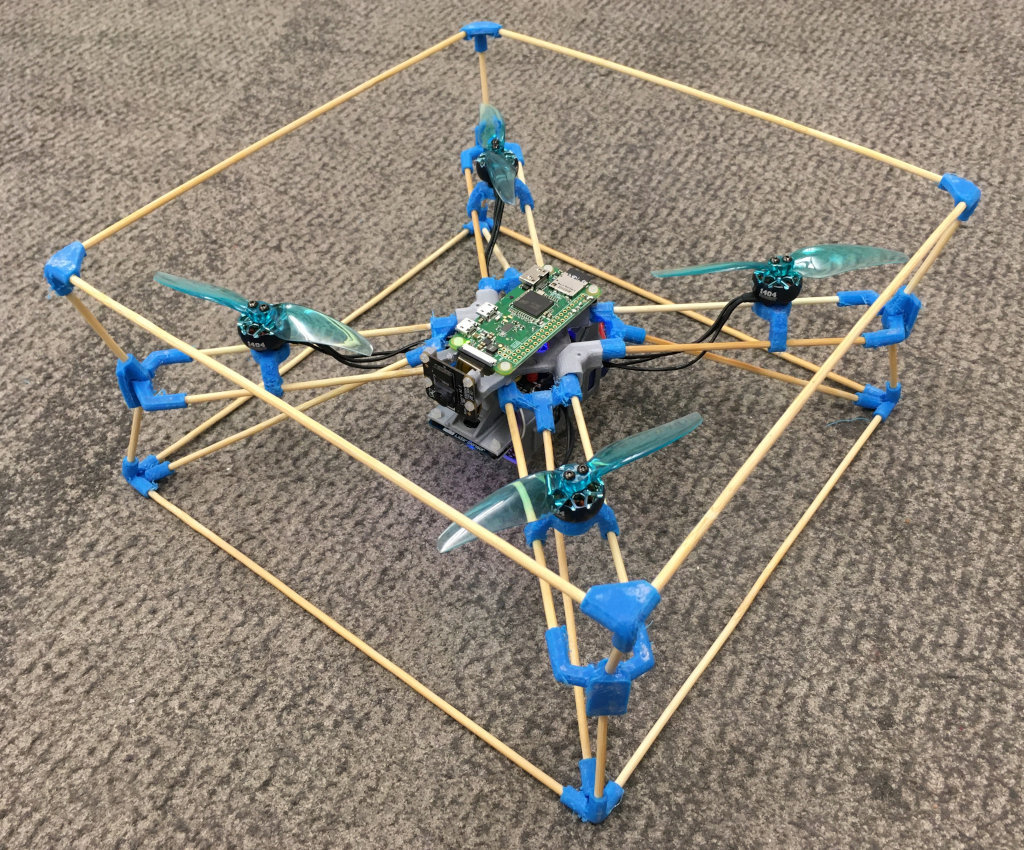
Quadcopter with a flexible exoskeleton-style frame of 3 mm sticks or rods joined by TPU parts; Version 2 bamboo build weighs 237 g
- Actuators
- Four XING2 1404 3000 KV brushless motors with Gemfan Hurricane 4024 propellers (Version 2)
Paper configuration used 1104 6000KV motors with 3025 propellers.
- Controller
JHEMCU GHF420 AIO F4 flight controller with 35A 4-in-1 ESC running INAV; Raspberry Pi Zero W companion computer
Paper configuration used Holybro Kakute F7 Mini V2 with a separate 4-in-1 ESC.
- Sensors
- Matek 3901-L0X optical flow and lidar sensor
- Raspberry Pi Camera V2
Assembly & first use
Open the upstream getting-started guide [3]
- Print TPU joints and PLA parts and cut 3 mm sticks or rods
- Assemble frame, motors, FC/ESC, optical-flow/lidar sensor and Raspberry Pi Zero W
- Check power connectors for shorts with a multimeter before connecting the battery
- Flash cognifly_framework.hex with INAV configurator 2.3.2 and load the CLI configuration
- Test motors without propellers, calibrate accelerometer and optical flow
- Flash the Raspberry Pi image and install cognifly-python
Editorial source-navigation sequence, not a reproduced or safety-qualified procedure.
Cost
| Version | Price |
|---|---|
| CogniFly Version 2, Raspberry Pi Zero W configuration without AIY Vision Kit (upstream Table 2) | CAD 407.90 [3] [4] Parts estimate |
Canada (supplier links dated 2021) · Checked 2026-10-05
| Included | Sticks, TPU and PLA filament; Four XING2 1404 motors and propellers; JHEMCU GHF420 FC/ESC; Matek optical flow and lidar; Raspberry Pi Zero W, camera V2, cable and SD card; Two 2S 2000 mAh batteries; Screws, wire, tape, hot glue |
|---|---|
| Not included | Shipping except the separately shipped Raspberry Pi; Taxes not stated; Tools including 3D printer and soldering iron; Battery charger and gamepad not listed; Optional AIY Vision Bonnet or Coral board |
| Stock | Upstream warns links may change and the Raspberry Pi Zero W and Matek sensor can be hard to find; not re-quoted. |
| Delivery and tax | Upstream says prices exclude shipping apart from the Raspberry Pi; taxes not stated. |
Price details
Upstream Table 2 total for one drone using Canada 2021 supplier links; whole filament spools, two batteries and multi-packs are priced in full. Upstream unit total falls to CAD 300.55 per drone for five drones. Its motor row lists quantity 4 but only CAD 20.50, so it is unclear whether all four motors are priced; the total may be low. Not a current quote.
Canada (supplier links dated 2021) · Checked 2026-10-05 · Quantity 1
Tools, charger, controller and shipping must be added.
3D preview
Preview not available yet. Design-source links are available. A configuration-matched assembly and its file-level reuse scope have not yet been reviewed for a hosted preview.
Model sources
Design-source links are available. A configuration-matched assembly and its file-level reuse scope have not yet been reviewed for a hosted preview.
Project notes
Pick one configuration before buying
The repository documents two builds. The root README lists the paper configuration: 1104 6000KV motors with 3025 propellers, a Kakute F7 Mini V2 flight controller, a 4-in-1 ESC and a 3S 650 mAh battery. The Version 2 instructions in the Latest folder use XING2 1404 3000KV motors, 4024 propellers, a JHEMCU GHF420 board combining flight controller and ESC, a Matek optical-flow and lidar sensor, a Raspberry Pi Camera V2 and a 2S 2000 mAh LiPo. This profile follows Version 2 as documented in the untagged January 31, 2023 commit; current part availability and compatibility were not established. [1] [3]
Version 2 reports 237 g with bamboo sticks, and 246 to 255 g with carbon rods depending on materials. The carbon option can exceed 250 g. Upstream reports a 17-minute flight from one long position-hold test, from 8.4 V down to 6.6 V. TPU joints take about 8 hours per drone to print, plus at least two PLA prints of about 4 hours. [3] [4]
What the published total covers
Table 2 totals CAD 407.90 for one drone with the Raspberry Pi Zero and no AIY Vision Kit, from Canadian supplier links dated 2021. Its motor row lists quantity 4 but only CAD 20.50 for one drone, so it is unclear whether all four motors are priced; confirm that row before relying on the total. It includes whole filament spools and two batteries, and falls to CAD 300.55 per drone when building five. It excludes shipping (except the Raspberry Pi order), tools, a battery charger and a gamepad, which the cognifly-python README recommends for manual control; taxes are not stated. Upstream warns the Raspberry Pi Zero W and Matek sensor can be hard to find. Treat it as a dated estimate, not a quote. [3] [4] [6]
What we checked
Source research only; no installation, physical build, flashing or flight test performed. No affiliate links added.
Not yet established
- Requirements: operating system
Updates
- Upstream last updated
- Jan 31, 2023 [2]
- Latest release
- Not established
- Profile updated
- Oct 26, 2026
- Sources last checked
- Oct 5, 2026
- Next review
- Nov 5, 2026
- Reviewed revision
- CogniFly-STL commit 64856403a5a75d0eb1932ae7ba9444652acd5b4a (snapshot, no release), Latest/ Building Instructions (Version 2); cognifly-python release v0.3.3 (52648e5ad7ee) · repository
Source files and licenses
Printable frame files and build instructions are public without an identified license; the Python control library is MIT. Covered as partial-source research with frame reuse rights unresolved.
| Layer | Availability / license |
|---|---|
| mechanical design | available · No license identified STL files for Version 2 TPU/PLA parts plus earlier versions. No license file identified in the inspected CogniFly-STL sources. Some earlier folders also include STEP/SAT files. [2] [3] |
| electronics | not found · License not fully assessed Uses purchased FC/ESC, sensor and Raspberry Pi boards; no custom electronics design files identified. Wiring is described in the build instructions. [3] |
| firmware | available · License not fully assessed Version 2 flashes a prebuilt cognifly_framework.hex from a cognifly-python release; README links an INAV fork (CogniFly branch). Neither the hex nor the fork source was preserved or inspected; GitHub repository metadata shows a GPL-3.0 hint for the fork, unverified here. [1] [5] |
| software | available · MIT cognifly-python v0.3.3 LICENSE file: MIT License, Copyright (c) 2021 The CogniFly Project. Raspbian image release asset not preserved. [6] |
| documentation | available · License not fully assessed Build instructions and README in CogniFly-STL. No license file identified in the inspected CogniFly-STL sources. cognifly-python documentation sits under that repository's MIT LICENSE. [1] [3] |
Optional AIY Vision Kit or Coral neural-network add-ons are outside the selected base build.
No dataset is part of the selected build.
Firmware, software and licenses
Setup flashes a prebuilt cognifly_framework.hex from a cognifly-python release with INAV configurator 2.3.2, loads a CLI configuration, tests motors with propellers removed and calibrates the accelerometer and optical flow. The README links a CogniFly fork of INAV, which was not preserved or inspected here. Upstream suggests checking for shorts with a multimeter before connecting the battery, and wearing safety glasses. [1] [4] [5] [7]
For Python control, flash the project's Raspberry Pi image or Raspberry Pi OS, install the cognifly package on both the Pi and the remote computer, and run cognifly-controller on the drone. [6] [7]
The cognifly-python library is MIT-licensed. No license file was identified for the CogniFly-STL frame files or build instructions, so frame reuse rights are unresolved. No build, flashing or flight was performed for this profile. [2] [6]
References
Each source links to the exact revision we read. “Used for” shows where this page relies on it.
- S001 CogniFly-STL README (paper configuration and caveats)
Original paper-configuration BOM (1104 motors, Kakute F7 Mini, 3S 650 mAh), INAV fork link, assembly caveats.Revision, date & where cited
The CogniFly Project (MISTLab contributors) · github.com · revision
6485640· README.md at · Accessed Oct 5, 2026
Used for: Is this for you?, Pick one configuration before buying, Source files and licenses - S002 CogniFly-STL revision metadata and Latest folder inventory
Selected commit, dates, popularity signals, no GitHub license hint, files in Latest/.Revision, date & where cited
The CogniFly Project (MISTLab contributors) · github.com · revision
6485640· ; commit snapshot, no published release; Latest/ member list · Accessed Oct 5, 2026
Used for: Is this for you?, What we checked, Source files and licenses - S003 Building Instructions (Version 2): overview and BOM tables 1-2
Version 2 configuration, 237 g bamboo weight, 17-minute reported flight, parts and Canada 2021 prices for the Raspberry Pi Zero configuration.Revision, date & where cited
The CogniFly Project (MISTLab contributors) · github.com · revision
6485640· Latest/readme.md from "# Building Instructions (Version 2)" to Table 3 · Accessed Oct 5, 2026
Used for: Overview, Is this for you?, What you need, Hardware & parts and 5 more - S004 Building Instructions (Version 2): price notes, print times and safety
Price exclusions, supplier availability caveats, print time and safety suggestions.Revision, date & where cited
The CogniFly Project (MISTLab contributors) · github.com · revision
6485640· Latest/readme.md price/shipping notes and safety precaution paragraph · Accessed Oct 5, 2026
Used for: Is this for you?, Hardware & parts, Assembly & first use, Cost and 3 more - S005 Building Instructions (Version 2): INAV setup
INAV configurator 2.3.2, cognifly_framework.hex and configuration from cognifly-python v0.0.4 release, motor-test and calibration steps.Revision, date & where cited
The CogniFly Project (MISTLab contributors) · github.com · revision
6485640· Latest/readme.md "## Software setup" through INAV steps · Accessed Oct 5, 2026
Used for: Overview, Is this for you?, What you need, Hardware & parts and 2 more - S006 cognifly-python README and license (release v0.3.3)
Python control library for remote and onboard control; MIT License.Revision, date & where cited
The CogniFly Project (MISTLab contributors) · github.com · revision
52648e5· README.md and LICENSE at (tag v0.3.3) · Accessed Oct 5, 2026
Used for: Overview, Is this for you?, What you need, What the published total covers and 1 more - S007 cognifly-python drone setup instructions
Flight controller flashing and Raspberry Pi image setup.Revision, date & where cited
The CogniFly Project (MISTLab contributors) · github.com · revision
52648e5· Accessed Oct 5, 2026
Used for: What you need, Assembly & first use, Source files and licenses - S008 The CogniFly Project website
Project purpose, sub-250 g rationale linked to Canadian regulations, hardware concept, publications.Revision, date & where cited
The CogniFly Project (MISTLab contributors) · thecognifly.github.io · Home page snapshot sha256 510866376921315b · Accessed Oct 5, 2026
Used for: Overview, Is this for you?, Hardware & parts - S009 Upstream image and reuse attribution
Media-only review: Photograph of the bamboo-frame CogniFly with Raspberry Pi Zero W, from Figure 4 of the September 2021 preprint. The figure identifies 1404/3000KV motors, 4-inch propellers and a 2S 2000mAh battery. Reuse basis: CC-BY-4.0. The catalog follows Latest/ Version 2 instructions at 64856403a5a75d0eb1932ae7ba9444652acd5b4a. Its bamboo option, XING2 1404 3000KV motors, Gemfan 4024 two-blade propellers, 2S 2000mAh battery, blue TPU junctions and Raspberry Pi Zero W match the Figure 4 configuration. The v2 paper section III.C includes JHEMCU GHF420 as a controller option, unlike the earlier v1-only configuration. The photo does not establish hidden electronics or firmware; no claim is made that it depicts the exact current software snapshot. The optional AIY Bonnet on the red prototype in Figure 1 is not used. Embedded image extracted from page 4 of the source PDF and losslessly decoded to PNG; no retouching. Technical/cost evidence dates unchanged.Revision, date & where cited
Ricardo de Azambuja, Hassan Fouad, Yann Bouteiller, Charles Sol and Giovanni Beltrame · arxiv.org · arXiv:2103.04423v2, page 4, Figure 4; embedded image index 0, 1024×850 pixels; image SHA-256 f48cd02af29be5ec7df0fcdf47fd7b0731c8640d9e1f9d1e0af00a1476d8efcc · Accessed Oct 26, 2026
Correction guidance · Discussion is not enabled · Profile format 0.7.0-draft.5
Change history
2026-10-05 — Initial intake from CogniFly-STL snapshot, cognifly-python v0.3.3 and project website (Growbotics comparison lead verified against upstream).
2026-10-26 — Added attributed upstream media with linked reuse terms; technical evidence dates unchanged.