Crazyflie
Robot / hardware buildSmall quadrotor development platform; this profile selects the brushed Crazyflie 2.1 hardware and distinguishes its firmware target from Brushless and Bolt variants. [5] [9]
Build & first use →Official website
- For
- Robotics developers able to match aircraft, firmware target, radio and positioning setup [1]
- Cost
- No current cost or bill of materials established yet.
- Source rights
- Some licenses are unresolved. Review licenses
- Unknowns
- tools not fully established. Review gaps
Source researched · Not tested by us
Sources checked · Research details
Licenses & related hardware
- License
- not fully assessed for electronics, firmware, software, documentation · Details by part
Overview
This profile selects the brushed Crazyflie 2.1, not the 2.1+ or Brushless configuration. Its revision 3 datasheet specifies an STM32F405 application processor, nRF51822 radio and power controller, BMI088 motion sensor and BMP388 pressure sensor. The kit uses four 7 mm coreless motors; the fifth listed motor is a spare. These details identify the selected hardware rather than every member of the Crazyflie family. [9]
Is this for you?
- Known limitations
- Firmware README says LGPL-3.0 while root license and inspected stabilizer source state GPL version 3
- A firmware archive alone does not establish complete submodule or radio firmware payloads
- Preserved 2.1 hardware set includes schematic PDFs, not a complete editable PCB manufacturing set
- No physical flight or build test performed
3D preview
Crazyflie 2.1 simplified simulation model (Bitcraze Gazebo model). The simplified Crazyflie 2.1 simulation model by Bitcraze: the Gazebo model.sdf of bitcraze/crazyflie-simulation at commit 7e93752, shown with its source link poses and the four propeller joints at zero: one body link (motors, motor mounts, frame board, battery, battery holder and pin headers as six low-polygon meshes) and four propellers, 10 meshes in total. The repository README calls these intentionally simplified low-resolution meshes based on the Crazyflie 2.1; they are not the detailed PCB or mechanical design files, and they do not represent the 2.1+, Brushless or Bolt variants or any expansion deck. The Webots PROTO in the same repository is licensed for use only with Webots and is not used. MIT License, Copyright (c) 2022-2024 Bitcraze. No manufacturing clearance is claimed. Fit and flight are not verified.
MIT License, “Copyright (c) 2022 Bitcraze” (repository LICENSE; the Gazebo model.sdf carries the same MIT notice, Copyright (c) 2024 Bitcraze). The Webots PROTO in the same repository says “Licensed for use only with Webots” and is neither used nor hosted. No manufacturing clearance is claimed. License: MIT License (crazyflie-simulation LICENSE) · upstream notice.
The 3D preview loads after the page.
Drag to orbit · Scroll or pinch to zoom · Right-drag to pan. Use the view buttons for front, side and top views. The tree shows names supplied by the source; unnamed bodies remain labeled as such.
Download original SDF source bundle (ZIP) · File checksums and provenance
Separate bodies can be inspected in the model tree. Explode is a viewing aid, not an assembly sequence.
Model sources
The preview uses the linked original design. Source grouping is retained where present; the caption identifies whether this is an assembly or one component.
Source, license and scale
Source: Bitcraze AB (model by Kimberly McGuire), revision 7e93752dbc803af2488c1db46bb79b3da55f5d8c. Original and preview: MIT. Preview conversion by Open Source Robotics; source files unchanged inside the downloadable bundle. Preview coordinates are centered and rounded to six decimal places. Source model, link and visual poses retained without simulating joints, then metres converted to millimetres. No physical part tested.
Viewer: three-cad-viewer 5.0.7 (MIT license). Confirm scale and manufacturing settings before printing.
What you need
- Operating system
- Linux ARM cross-toolchain
- macOS ARM cross-toolchain
- Windows using WSL for build and native Windows client for flashing
Upstream build routes, not tested installations.
- Host computer
Computer with Crazyradio and client for the documented development/firmware workflow; mobile Bluetooth control is a separate reported option.
Hardware & parts
Assembly & first use
- Assembly
Upstream kit is described as solder-free assembly; propellers, motor mounts, battery and deck connectors must match the selected aircraft.
Cost
No current, complete configuration-specific build cost has been established for this profile.
Project notes
Firmware targets are model-specific
The preserved build guide uses cf2_defconfig for Crazyflie 2.0 and 2.1(+), cf21bl_defconfig for 2.1 Brushless and bolt_defconfig for Bolt. The platform documentation explains that supported device types can select different sensor drivers at runtime, while an unsupported hardware identifier causes the firmware to halt. A shared product name is therefore not enough to choose a binary. [5] [6]
The README separately says the 2017.06 release was the last with Crazyflie 1.0 support. Do not infer support for that older aircraft from the selected modern archive. [1]
A source archive is only part of the development environment
The documented build needs an ARM toolchain and make, with recursive Git submodules for components including CMSIS, FreeRTOS, CMock, Unity and libdw1000. The preserved primary archive does not establish complete matching submodule payloads. The build guide also warns that spaces in the checkout path are unsupported. No compilation or unit tests from upstream were run here. [5] [7]
For radio flashing, the guide requires Crazyradio, its drivers and the Crazyflie client. Its Windows route builds under WSL but uses the client installed on Windows. The guide distinguishes discovery-based bootloader flashing from an address-specific route, warning that several aircraft in bootloader mode make discovery ambiguous. This is an upstream configuration requirement, not a flashing procedure verified by this review. [5]
The selected aircraft has a second MCU for radio and power management. This review covers the main firmware archive and does not claim that every matching firmware component or external positioning setup has been preserved. A complete delivered cost also depends on the radio, host and selected decks, not just the aircraft kit. [5] [7] [9]
What we checked
Source research only; no installation, physical build or performance test performed. No affiliate links added.
Not yet established
- Requirements: tools
- A step-by-step setup summary
Updates
Source files and licenses
Available project sources support research coverage; complete build and commercial qualification remain separate.
| Layer | Availability / license |
|---|---|
| mechanical design | not found · License not fully assessed Dimensions and product illustrations documented, but complete matching editable mechanical design not established in selected 2.1 directory. [9] [10] |
| electronics | available · License not fully assessed Schematic revision B and component-placement PDFs preserved. Complete editable PCB files and matching hardware rights not established. [10] |
| firmware | available · License not fully assessed Source available; README LGPL-3.0 conflicts with root GPLv3 text and stabilizer GPLv3 notice. Whole-tree licensing not normalized; individual components retain their terms. Separate radio/power firmware not reviewed. [1] [3] [7] [8] |
| software | available · License not fully assessed Build and test tooling in primary firmware archive; complete external client and dependency set not reviewed. Firmware license inconsistency remains. [5] [7] [8] |
| documentation | available · License not fully assessed Repository documentation available; blanket licensing remains unresolved due inconsistent repository notices. [1] [3] [5] [6] |
Selected conventional flight firmware development route requires no pretrained policy or dataset.
Hardware documents and source rights have separate limits
The preserved hardware repository includes the 2.1 datasheet, a revision B schematic PDF and a component-placement PDF. Those help identify the design, but do not establish a complete editable PCB or mechanical manufacturing package in the selected 2.1 directory. Hardware-specific rights remain unresolved. [9] [10]
There is also a licensing inconsistency in the firmware snapshot: its README says LGPL-3.0, while LICENSE.txt contains GPL version 3 and the inspected stabilizer.c header explicitly grants GPL version 3. The profile records that conflict rather than assigning one unqualified license to the entire tree. Dependencies need their own notice review. [1] [3] [7] [8]
No kit assembly, firmware installation, radio test, positioning experiment or flight was performed. The entry supports choosing and preserving a configuration for further work; it does not validate flight performance or a complete reproduction. [5] [9] [10]
References
Each source links to the exact revision we read. “Used for” shows where this page relies on it.
Project sources
- S001 bitcraze/crazyflie-firmware: README.md
Revision, date & where cited
github.com · revision
54f31e2· Accessed Oct 1, 2026
Used for: Is this for you?, Assembly & first use, Firmware targets are model-specific, Source files and licenses - S002 bitcraze/crazyflie-firmware: commit 54f31e2
- S003 bitcraze/crazyflie-firmware: LICENSE.txt
Revision, date & where cited
github.com · revision
54f31e2· Accessed Oct 1, 2026
Used for: Is this for you?, Source files and licenses - S004 bitcraze/crazyflie-firmware: files
Revision, date & where cited
github.com · revision
54f31e2· archive file inventory · Accessed Oct 1, 2026 - S005 Crazyflie firmware docs/building-and-flashing/build.md
Revision, date & where cited
github.com · revision
54f31e2· Accessed Oct 1, 2026
Used for: Is this for you?, What you need, Firmware targets are model-specific, A source archive is only part of the development environment and 1 more - S006 Crazyflie firmware docs/userguides/platform.md
Revision, date & where cited
github.com · revision
54f31e2· Accessed Oct 1, 2026
Used for: Firmware targets are model-specific, Source files and licenses - S007 Crazyflie firmware .gitmodules
Revision, date & where cited
github.com · revision
54f31e2· Accessed Oct 1, 2026
Used for: Is this for you?, What you need, A source archive is only part of the development environment, Source files and licenses - S008 Crazyflie firmware src/modules/src/stabilizer.c
Revision, date & where cited
github.com · revision
54f31e2· Accessed Oct 1, 2026
Used for: Is this for you?, Source files and licenses - S009 Crazyflie 2.1 datasheet revision 3
Revision, date & where cited
github.com · revision
8207400· Accessed Oct 1, 2026
Used for: Overview, What you need, Hardware & parts, Assembly & first use and 2 more - S010 Crazyflie 2.1 hardware file inventory
Revision, date & where cited
github.com · revision
8207400· selected archive inventory · Accessed Oct 1, 2026
Used for: Is this for you?, Source files and licenses - S012 Upstream image and reuse attribution
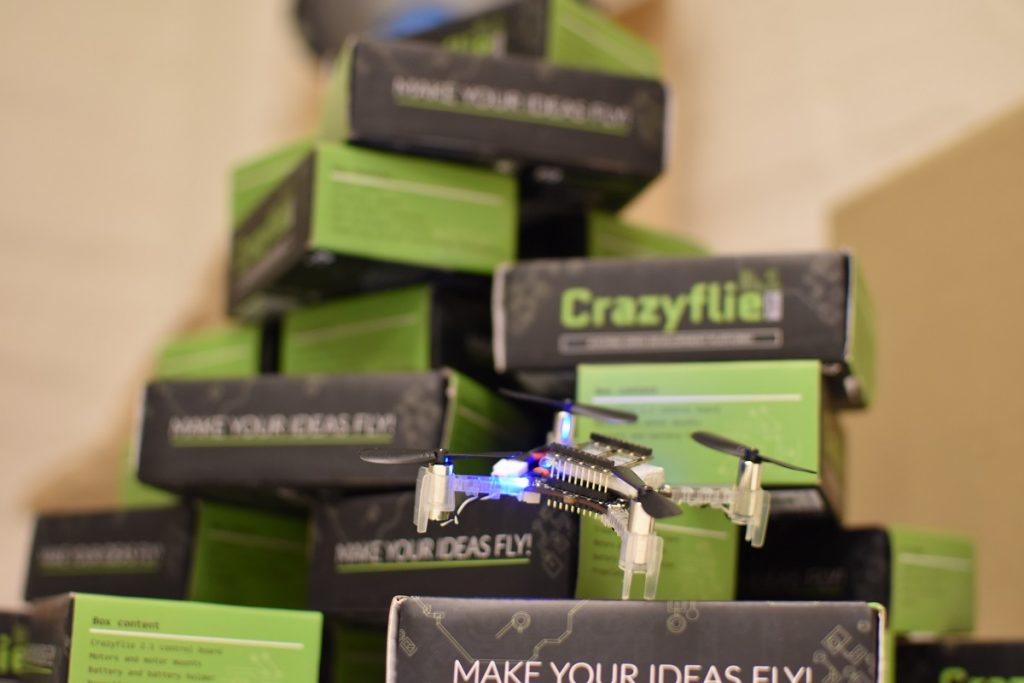
Media-only review: Upstream photograph of a brushed Crazyflie 2.1 in Bitcraze’s July 2019 stock announcement. Reuse basis: CC-BY-3.0. The source post specifically identifies Crazyflie 2.1; four brushed motors and original frame are visible. This is not the Brushless or Bolt variant. The website license page explicitly applies its linked CC BY 3.0 content declaration to this site. No flight performance claim. Original image unchanged; displayed responsively. Technical/cost evidence dates unchanged.Revision, date & where cited
Bitcraze AB; source post by Kimberly McGuire · bitcraze.io · July 17, 2019 post, main photograph DSC_0235_small; image SHA-256 75bcaf7fbeb0d7b64bb4c8a39db3b147bb474c79983fe8849e3a972c8c8d1341 · Accessed Oct 26, 2026
Videos
- S011 Bitcraze (YouTube channel)
The project’s own YouTube channel, found by searching YouTube and checked against the channel page. Not reviewed by us for accuracy.Revision, date & where cited
YouTube channel Bitcraze · youtube.com · Accessed Oct 4, 2026
Correction guidance · Discussion is not enabled · Profile format 0.6.0-draft.1
Change history
2026-10-04 — Added 1 YouTube reference(s) (S011): official channel or videos linked from the pinned upstream sources. Existing claims, source-check dates and evidence are unchanged.
2026-10-26 — Added attributed upstream media with linked reuse terms; technical evidence dates unchanged.