Duke Humanoid v1
Robot / hardware buildTen-degree-of-freedom research biped with machined aluminum parts, EtherCAT motor control and learned locomotion; artifact and dependency licenses need separate checks. [1]
Build & first use →Official websiteBill of materials
- For
- Research teams able to manufacture, commission and validate a powered biped [1]
- Cost
- No current cost yet. Upstream bill of materials [7]
- Source rights
- Some licenses are unresolved. Review licenses
- Unknowns
- tools, operating system not fully established. Review gaps
Source researched · Not tested by us
Sources checked · Research details

Licenses & related hardware
- License
- MIT · license not fully assessed for mechanical design, electronics, software, model weights, documentation · Details by part
Overview
Duke Humanoid V1 is a ten-degree-of-freedom research biped for locomotion and passive-dynamics-aware control. The parent repository links separate hardware-control and simulation repositories. This review preserved the exact gitlink revisions, rather than replacing them with each repository's newest branch. Research results reported by the authors are not tests performed by this publication. [1] [2] [5] [6]
Is this for you?
- Known limitations
- README environment filename setup/conda_env_py38.yaml is absent in both pinned submodule archives
- Parent MIT license does not resolve all submodule, CAD or policy-weight rights
- Manufacturing attachments are visibly available but not preserved or dimensionally validated in this review
- No complete current delivered budget, physical build or locomotion result verified
Source comparison and review scope.
3D preview
Duke Humanoid v1 biped simulation robot description. The biped robot description used by the Duke Humanoid v1 simulation and learning code: v6biped_urdf_v4_squarefoot_aug29.urdf in the General Robotics Lab legged_env repository at commit 8b21398, which is the exact submodule revision of DukeHumanoidv1 commit 0700cfb and the asset named in envs/cfg/task/Biped.yaml. It is shown at zero joint positions: 19 link meshes on the source joint tree, with the 10 revolute leg joints; knee and ankle linkage parts are fixed links in the source description. This is the square-foot variant; alternative foot meshes in the download are not shown. It is a simulation description, not the machined-part manufacturing CAD or the Fusion assemblies. No license file was identified for legged_env and the MIT license of the parent repository is not assumed to cover it, so no reuse, manufacturing or redistribution clearance is claimed. Fit and motion are not verified.
No license identified: the legged_env repository that contains this robot description (commit 8b21398, the exact submodule revision of DukeHumanoidv1 commit 0700cfb) has no license file or license statement. The parent DukeHumanoidv1 repository is MIT-licensed (“Copyright (c) 2024 General Robotics Lab - Duke University”) and its README calls the robot “an open-source 10-degrees-of-freedom humanoid”, but that license is not assumed to cover the separate legged_env repository. Open Source Robotics shows this simulation description for reference with attribution to the General Robotics Lab at Duke University; no reuse, manufacturing or redistribution clearance is claimed. License: none identified (legged_env at 8b21398 has no license file) · upstream notice.
The 3D preview loads after the page.
Drag to orbit · Scroll or pinch to zoom · Right-drag to pan. Use the view buttons for front, side and top views. The tree shows names supplied by the source; unnamed bodies remain labeled as such.
Download original URDF source bundle (ZIP) · File checksums and provenance
Separate bodies can be inspected in the model tree. Explode is a viewing aid, not an assembly sequence.
Model sources
The preview uses the linked original design. Source grouping is retained where present; the caption identifies whether this is an assembly or one component.
Source, license and scale
Source: General Robotics Lab, Duke University, revision 8b21398ffaa2abc8f4d2c599f2c0c11122dfe5a1. Original and preview: No license identified (legged_env submodule has no license file; parent DukeHumanoidv1 MIT not extended). Preview conversion by Open Source Robotics; source files unchanged inside the downloadable bundle. Preview coordinates are centered and rounded to six decimal places. URDF visual origins, mesh scales and joint transforms applied at zero joint positions, then metres converted to millimetres. No physical part tested.
Viewer: three-cad-viewer 5.0.7 (MIT license). Confirm scale and manufacturing settings before printing.
What you need
Hardware & parts
Upstream bill of materials [7]
- Hardware configuration
Ten-degree-of-freedom research biped with articulated legs.
- Actuators
- Motorevo PA100 geared motors; wiki lists ratios 10, 18 and 20
- Motor controllers communicate via EtherCAT
- Controller
EtherCAT motor-controller chain with host-side hardware control; Teensy sensor firmware is included in the pinned control repository.
- Power
Wiki describes four 48 V Meanwell RSP-2000-48 supplies in current-sharing configuration and a 0.33 F capacitor.
Documented laboratory configuration, not an independently validated wiring or power design.
- Degrees of freedom
10
Assembly & first use
- Preserve the parent and exact control/simulation gitlinks together
- Select manufacturing files and match symmetric/mirrored parts from the wiki
- Resolve environment filenames and dependency rights before setup
- Commission sensors and motor configuration against the hardware documentation
- Use documented alignment and trajectory checks before locomotion experiments
Editorial research sequence; no hardware procedure executed.
- Assembly
Combine outsourced aluminum 6061 CNC parts with printed mounts, protection and feet; the wiki provides part-specific printing settings and linked assembly demonstrations.
- Calibration
Wiki requires alignment pieces and per-motor offset initialization at each power-on, followed by trajectory checks; hanging real/sim trajectory matching is described separately.
Cost
No current, complete configuration-specific build cost has been established for this profile.
Project notes
A machined research platform with substantial commissioning
The public bill-of-materials page distinguishes symmetric parts from mirrored left/right parts and exposes a spreadsheet, a CNC/DIY archive and full Fusion assemblies. Their availability is visible in the wiki; this review has not preserved or dimensionally validated those manufacturing downloads. The manufacturing guide specifies aluminum 6061, ISO 2768 medium tolerance and Ra3.2 roughness for outsourced CNC parts, alongside part-specific PLA, PLA-CF and TPU printing settings. [7] [8]
The electronics guide describes Motorevo PA100 motors with several reduction ratios, EtherCAT communication and Elmo Studio configuration. Its laboratory power arrangement uses four 48 V Meanwell supplies with current sharing and a capacitor. These are source-reported system choices, not an independently checked wiring design or a current purchasable kit. No complete delivered build budget is established here. [9]
Resolve the setup filenames before following the examples
The hardware README reports Ubuntu 22.04 with CUDA 12.3, GCC 12, CMake, vcpkg and a Python 3.8 environment. The simulation route uses Isaac Gym and rl_games. Both pinned READMEs name setup/conda_env_py38.yaml, but that file is absent from the inspected archives. The actual environment files are setup/conda_env.yaml in hardware control and envs/setup/conda_env.yaml in simulation. Their presence does not establish that they are interchangeable with the missing named configuration; inspect their contents before reproducing the setup. [5] [6] [11]
Control also has a nested SOEM dependency. Preserving the parent archive alone would omit both principal submodules and this further dependency, so a repository download is not by itself a complete reproducible environment. [1] [5] [11]
Calibration is part of the workflow
The wiki calls for joint initialization at each power-on using alignment pieces, with motor offsets recorded by the controller. It separately describes comparing hanging hardware and simulated joint trajectories while adjusting the model. Those steps explain why a policy checkpoint alone is not enough to commission another build. No sensor calibration, motor tuning, trajectory test or walking trial was performed here. [10]
What we checked
Source research only; no installation, physical build or performance test performed. No affiliate links added.
Not yet established
- Requirements: operating system, tools
Updates
- Upstream last updated
- Jun 22, 2025 [2]
- Latest release
- Not established
- Profile updated
- Oct 25, 2026
- Sources last checked
- Sep 30, 2026
- Next review
- Oct 30, 2026
- Reviewed revision
- 0700cfbfe4e68b0db8c12a351f4c7dc449524356 (commit snapshot; no published stable release found) · combined hardware and software repository
Source files and licenses
Available project sources support research coverage; complete build and commercial qualification remain separate.
| Layer | Availability / license |
|---|---|
| mechanical design | available · License not fully assessed Wiki exposes CNC/DIY ZIP and full Fusion assembly attachments. File contents and artifact-specific reuse license not verified; simulation meshes are not a substitute manufacturing pack. [7] [8] |
| electronics | available · License not fully assessed System integration documentation and purchased motor/drive components; not a complete independently licensed board-manufacturing set. [9] |
| firmware | available · MIT Explicit MIT notice in this Teensy sketch only; external Arduino libraries retain their own terms. [11] |
| software | available · License not fully assessed Parent repository is MIT, but separate submodule rights are not resolved by inheritance. Selected simulation files retain differing NVIDIA notices; Isaac Gym is an external dependency. [3] [5] [6] [11] |
| model weights | available · License not fully assessed Duke baseline/passive checkpoint files preserved; hardware archive also contains ONNX policies. Artifact-specific license and execution not verified. [6] [11] |
| documentation | available · License not fully assessed Public hardware wiki captured as research evidence; wiki-wide reuse license not established and no imagery republished. [5] [7] [8] [9] [10] |
This source profile selects the documented simulator and provided policy checkpoints, not a separately distributed training dataset.
Keep the license boundaries explicit
The parent repository has an MIT license. The separate pinned repositories have no license-named file in their inventories, while selected source headers include an MIT notice in the Teensy sketch and differing NVIDIA notices in simulation files. Do not infer that the parent's MIT license covers all submodule code, Isaac Gym, third-party meshes, manufacturing attachments or policy weights. Baseline/passive checkpoints and hardware ONNX policies are preserved as artifacts, but their specific reuse rights and execution remain unverified. [3] [11]
This is a source map for a research platform with useful hardware documentation. It is not a validated build pack, a fully resolved open-hardware license claim or a tested locomotion implementation. [7] [8] [9] [11]
References
Each source links to the exact revision we read. “Used for” shows where this page relies on it.
Project sources
- S001 generalroboticslab/DukeHumanoidv1: README.md
Revision, date & where cited
github.com · revision
0700cfb· Accessed Sep 30, 2026
Used for: Overview, Hardware & parts, Resolve the setup filenames before following the examples - S002 generalroboticslab/DukeHumanoidv1: commit 0700cfb
- S003 generalroboticslab/DukeHumanoidv1: LICENSE
Revision, date & where cited
github.com · revision
0700cfb· Accessed Sep 30, 2026
Used for: Is this for you?, Source files and licenses - S004 generalroboticslab/DukeHumanoidv1: files
Revision, date & where cited
github.com · revision
0700cfb· archive file inventory · Accessed Sep 30, 2026 - S005 Pinned submodule README: dukeHumanoidHardwareControl
Revision, date & where cited
github.com · revision
3a9c3cd· Accessed Sep 30, 2026
Used for: Overview, What you need, Hardware & parts, Assembly & first use and 2 more - S006 Pinned submodule README: legged_env
Revision, date & where cited
github.com · revision
8b21398· Accessed Sep 30, 2026
Used for: Overview, What you need, Assembly & first use, Resolve the setup filenames before following the examples and 1 more - S007 Public hardware wiki: wiki-bom-attachments
Revision, date & where cited
generalroboticslab / project contributors · sleepy-yoke-a21.notion.site · Visible expanded wiki section captured 2026-09-30 · Accessed Sep 30, 2026
Used for: Is this for you?, Hardware & parts, Assembly & first use, A machined research platform with substantial commissioning and 1 more - S008 Public hardware wiki: wiki-manufacturing
Revision, date & where cited
generalroboticslab / project contributors · sleepy-yoke-a21.notion.site · Visible expanded wiki section captured 2026-09-30 · Accessed Sep 30, 2026
Used for: What you need, Assembly & first use, A machined research platform with substantial commissioning, Source files and licenses - S009 Public hardware wiki: wiki-motors
Revision, date & where cited
generalroboticslab / project contributors · sleepy-yoke-a21.notion.site · Visible expanded wiki section captured 2026-09-30 · Accessed Sep 30, 2026
Used for: Hardware & parts, Assembly & first use, A machined research platform with substantial commissioning, Source files and licenses - S010 Public hardware wiki: wiki-deployment
Revision, date & where cited
generalroboticslab / project contributors · sleepy-yoke-a21.notion.site · Visible expanded wiki section captured 2026-09-30 · Accessed Sep 30, 2026
Used for: Assembly & first use, Calibration is part of the workflow, Source files and licenses - S011 Pinned artifact and file-license inspection
Revision, date & where cited
github.com · revision
0700cfb· Exact gitlink archives; filename inventory and selected file headers · Accessed Sep 30, 2026
Used for: Is this for you?, What you need, Hardware & parts, Assembly & first use and 2 more - S013 Upstream image and reuse attribution
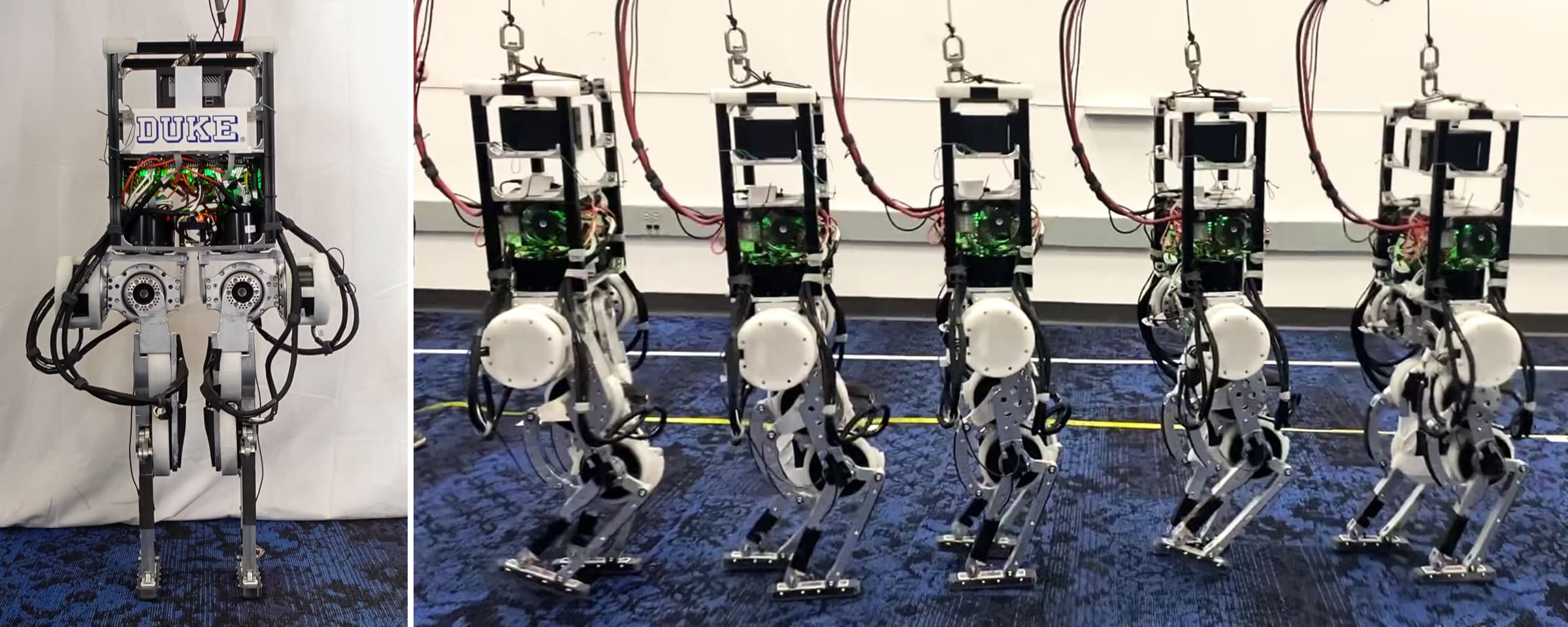
Media-only review: Upstream photograph montage of Duke Humanoid v1 in several poses. Reuse basis: MIT; inspected LICENSE and the pinned file inventory for nearer notices. Original image unchanged; displayed responsively. This does not refresh technical or cost evidence.Revision, date & where cited
General Robotics Lab, Duke University · github.com · revision
0700cfb· Image SHA-256 1b4ceeeb7543875c7ac518b06db17656f27be675ed894df05f65486ff624829d; repository · Accessed Oct 25, 2026
Videos
- S012 The Duke Humanoid: Design and Control For Energy Efficient Bipedal Locomotion Using Passive Dynamics (YouTube video)
Video from the project’s own channel (General Robotics Lab), linked from the project’s own documentation. Not reviewed by us for accuracy.Revision, date & where cited
YouTube video General Robotics Lab · youtube.com · Accessed Oct 4, 2026
Correction guidance · Discussion is not enabled · Profile format 0.6.0-draft.1
Change history
2026-10-04 — Added 1 YouTube reference(s) (S012): official channel or videos linked from the pinned upstream sources. Existing claims, source-check dates and evidence are unchanged.
2026-10-25 — Added an attributed upstream image with linked reuse terms; technical evidence dates unchanged.