HapCompass
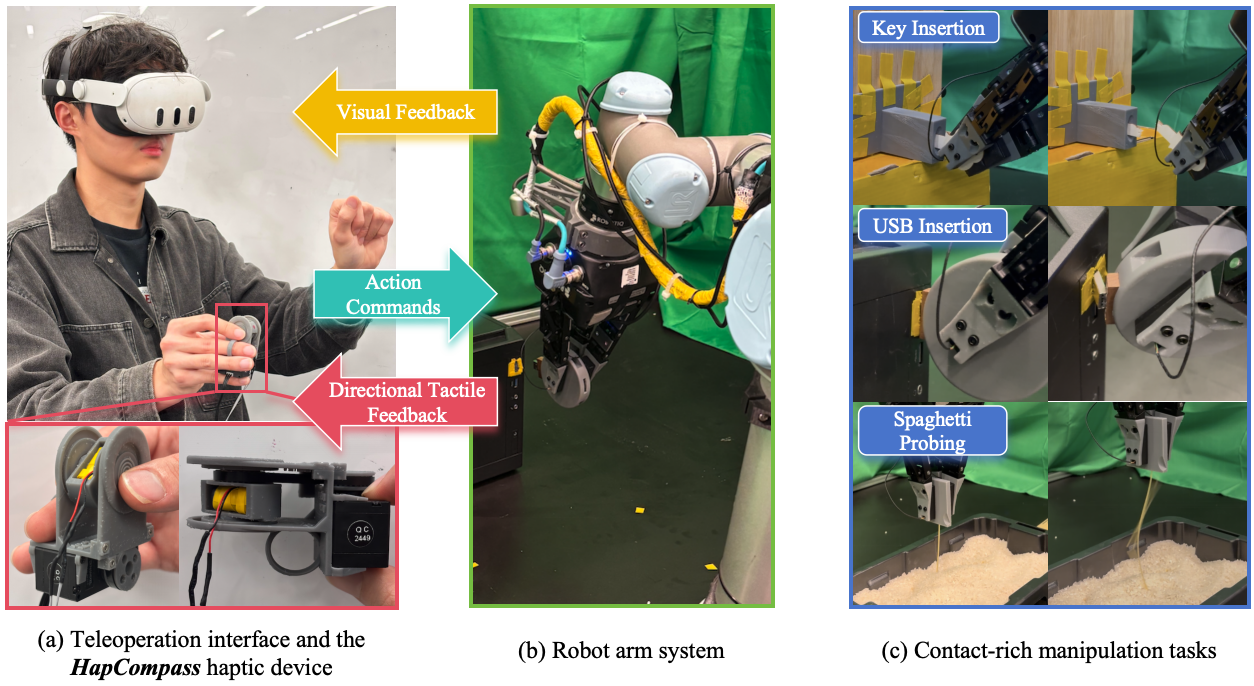
Haptic peripheralFingertip-worn haptic device that rotates one linear resonant actuator with a Dynamixel servo to render 2D directional cues during robot teleoperation; printable parts, an editable source design and a priced BOM are released, but no control code was identified. [1] [4] [5]
Build & first use →Official websiteUpstream build guideBill of materials
- For
- Teleoperation and imitation-learning researchers with a tactile-sensing robot setup who can write their own device-control and force-mapping code [1] [5] [6]
- Cost
- USD 241.12 upstream parts estimate [4] · checked Oct 5, 2026 · DetailsNot included: resin printing material and printer, screws and nuts (unpriced) and two 5 V power supplies, audio and USB-C cables and more.
- Source rights
- Named licenses are documented by part. Review licenses
- Unknowns
- operating system not fully established. Review gaps
Source researched · Not tested by us
Sources checked · Research details

Licenses & related hardware
- License
- MIT (repository license) · Details by part
Overview
HapCompass is a fingertip-worn haptic device from RIPL at the Toyota Technological Institute at Chicago, published at ICRA 2026. It rotates a single linear resonant actuator (LRA) with a servo. An asymmetric drive waveform then produces a pulling sensation in the direction the actuator faces, which the authors use to turn a robot's tactile force changes into 2D directional cues for the operator. [1] [6] It is a teleoperation peripheral, not a robot, and suits researchers who already run a teleoperation setup with tactile sensing on the robot side.
Is this for you?
- Use cases
- Directional haptic feedback during contact-rich teleoperation (upstream tasks: key insertion, USB insertion, spaghetti probing)
- Collecting teleoperated demonstrations for imitation learning
- Known limitations
- Device-control, tactile-mapping and teleoperation code not identified in the pinned repository, although the arXiv abstract says the interface code is released
- Hardware README says the released design was slightly modified from the paper version
- Instructions for modifying the source design are marked "Coming soon"
- Critical fit dimensions may need adjustment for printer and bearing variation
Source-review boundaries; no build or test.
What you need
- Host computer
PC with a speaker output (3.5 mm audio) to drive the LRA through the amplifier and a USB-C connection to the servo driver board.
- Tools
- Resin 3D printer (upstream used a Formlabs Form 3 with Grey resin at 0.050 mm layers)
- Soldering equipment for extending the LRA leads
- Tweezers and glue for the optional O-ring step
Hardware & parts
Upstream bill of materials [4]
- Hardware configuration
Wearable fingertip haptic device: a servo-rotated rotor carrying one linear resonant actuator inside a two-part shell; a teleoperation peripheral, not a robot.
- Actuators
- Dynamixel XL330-M077-T servo
- Titan Haptics TacHammer DRAKE LFi (4 ohm) linear resonant actuator
- Controller
Waveshare serial bus servo driver board for the servo and a PAM8406 5 V audio amplifier board for the LRA, both commanded from a PC.
- Power
A 5 V supply for the amplifier board and a 5 V supply for the servo driver board.
Assembly & first use
Open the upstream getting-started guide [4]
- Order the BOM parts and print the six STL parts
- Check the critical fit dimensions against your printer and bearings
- Assemble rotor, bearings, shells, servo and belt
- Extend the LRA leads, connect it to the audio amplifier and the servo to the driver board
- Write or obtain host software that sets servo angle and LRA waveform from robot contact data
Editorial source-navigation sequence; the last step has no released code identified.
- Assembly
Six documented mechanical steps (rotor with bearings and inner shells, motor pulley, servo and belt, optional O-rings, belt fitting, shell closure) and four electronic steps (LRA wiring, polarity, amplifier and servo-driver connections).
Cost
| Version | Price |
|---|---|
| One HapCompass device, purchased parts as listed in hardware/README.md | USD 241.12 [4] Parts estimate |
US-linked suppliers in the upstream BOM; destination unspecified · Checked 2026-10-05
| Included | Four-pack of TacHammer DRAKE LFi LRAs; Dynamixel XL330-M077-T servo; MXL belt; Ball bearing pack; PAM8406 amplifier board; Waveshare servo driver board; Optional O-ring pack (upper bound only) |
|---|---|
| Not included | Resin printing material and printer; Screws and nuts (unpriced); Two 5 V power supplies, audio and USB-C cables; PC and robot-side tactile sensing; Shipping and taxes not established |
| Stock | Supplier stock and prices not re-quoted; README prices undated. |
| Delivery and tax | Not established. |
Price details
Our sum of the purchase prices listed in the hardware README (LRA 4-pack USD 180, servo 27.49, belt 1.63, bearing pack 14, amplifier 13, servo driver 5); the upper bound adds the optional O-ring pack (6.49). Screws are unpriced. Prices carry no date; pack prices exceed single-unit need.
US-linked suppliers in the upstream BOM; destination unspecified · Checked 2026-10-05 · Quantity 1
Printed parts, power supplies, cables, a PC, a teleoperated robot with tactile sensing, and self-written control code.
Cost
Summing the README's listed prices gives about USD 241, or USD 248 with the optional O-rings. That total includes a four-pack of LRAs at USD 180 and a bearing pack at USD 14. Screws are unpriced and the prices are undated. Printing, power supplies, cables, the PC and the robot are excluded. [4]
3D preview
Preview not available yet. Design-source links are available. A configuration-matched assembly and its file-level reuse scope have not yet been reviewed for a hosted preview.
Model sources
Design-source links are available. A configuration-matched assembly and its file-level reuse scope have not yet been reviewed for a hosted preview.
Project notes
What upstream reports
The project page reports three studies: users identifying 4 and 8 cue directions, teleoperated key insertion, USB insertion and spaghetti probing, and a preliminary imitation-learning test. In the last, policies trained on 10 demonstrations collected with directional feedback outperformed policies trained with non-directional controller feedback. [6] These are the authors' results; nothing was reproduced here.
Building the device
The hardware README lists one Titan Haptics TacHammer DRAKE LFi LRA, a Dynamixel XL330-M077-T servo, an MXL belt, two small bearings, optional O-rings, M2 screws, a PAM8406 audio amplifier board and a Waveshare serial-bus servo driver. Six parts are 3D printed; upstream used a Formlabs Form 3 with grey resin at 0.050 mm layers. [4] The PC drives the LRA through its 3.5 mm audio output and the amplifier, and commands the servo over USB-C through the driver board; each board needs its own 5 V supply. [4]
Two cautions come from the README itself. Some fit dimensions are critical to transmitting vibration, and printer or bearing variation may require editing them, but the section on modifying the source design says "Coming soon". The released design was also slightly modified from the paper version to improve stability. [4]
The software gap
The arXiv abstract says the teleoperation-interface code is released and links the project page. [7] The pinned repository tree (commit dated 2026-09-29) contains the README, license, project-page assets, one .f3z source design and six STL files, and no code files. The README's software to-do items (device control, tactile mapping, teleoperation) are commented out. [1] [5] A builder should expect to write the waveform generation, servo control and force-to-cue mapping from the project-page description. [6]
What we checked
Source research only; no printing, assembly, wiring or test performed. The catalog makes no safety or body-worn suitability assessment. Cost total is our arithmetic on upstream-listed prices. No affiliate links.
Not yet established
- Requirements: operating system
Updates
- Upstream last updated
- Sep 29, 2026 [2]
- Latest release
- Not established
- Profile updated
- Oct 25, 2026
- Sources last checked
- Oct 5, 2026
- Next review
- Nov 5, 2026
- Reviewed revision
- 5b11d813b3ed3d2f7e809af9a85c41de93d1e391 (main commit snapshot dated 2026-09-29; no published release found) · repository
Source files and licenses
Mechanical design, BOM and assembly documentation are released under the repository MIT license; control software was not identified. Included as a wearable teleoperation peripheral (category other), not a robot.
| Layer | Availability / license |
|---|---|
| mechanical design | available · MIT (repository license) One .f3z source and six STL files listed; payloads not preserved or geometry-checked. The MIT text refers to "Software"; its application to CAD files rests on the repository-level placement. Purchased LRA, servo and boards are not covered. [3] [4] [5] |
| electronics | not found · License not fully assessed No custom PCB; the device uses purchased amplifier and servo driver boards, with wiring steps documented in the hardware README. [4] |
| software | not found · License not fully assessed README software to-do items (device control, tactile mapping, teleoperation) are commented out and no code files appear in the pinned tree, although the arXiv abstract says the teleoperation-interface code is released. [1] [5] [7] |
| documentation | available · MIT (repository license) Hardware README with BOM, print settings and assembly; covered by the repository-level MIT file. [3] [4] |
Purchased servo and boards run vendor firmware; no custom firmware is part of the design.
Device hardware profile; the paper's imitation-learning policies are outside this configuration and were not identified as released.
Device hardware profile; demonstration data from the paper were not identified as released and are outside this configuration.
License and unknowns
The repository carries an MIT license (2026, RIPL) whose text refers to "the Software". It is the only license file found; applying it to the CAD and STL files is an inference from its repository-level placement, as there is no separate hardware notice. [3] [5] The full repository archive exceeds this catalog's 150 MiB intake limit, mostly because of project-page videos, so the .f3z and STL files were listed but not preserved or checked. [2] [5] The catalog makes no safety assessment for body-worn use, and no part was printed, assembled or tested.
References
Each source links to the exact revision we read. “Used for” shows where this page relies on it.
- S001 HapCompass README
Device overview, authors and affiliations, to-do list (software items commented out), hardware pointer.Revision, date & where cited
RIPL, Toyota Technological Institute at Chicago / HapCompass authors · github.com · revision
5b11d81· README.md at main commit snapshot · Accessed Oct 5, 2026
Used for: Overview, Is this for you?, The software gap, Source files and licenses - S002 ripl/HapCompass: commit 5b11d81
Commit date 2026-09-29; full archive blocked by the 150 MiB intake limit; dated popularity counts.Revision, date & where cited
RIPL, Toyota Technological Institute at Chicago / HapCompass authors · github.com · (default-branch snapshot; no stable release); GitHub API metadata · Accessed Oct 5, 2026
Used for: What we checked, Source files and licenses - S003 ripl/HapCompass: LICENSE
MIT License, Copyright (c) 2026 RIPL.Revision, date & where cited
RIPL, Toyota Technological Institute at Chicago / HapCompass authors · github.com · revision
5b11d81· Accessed Oct 5, 2026
Used for: Source files and licenses - S004 Hardware documentation and BOM
BOM with USD prices, print settings, critical dimensions, mechanical and electronic assembly; source-design instructions "Coming soon".Revision, date & where cited
RIPL, Toyota Technological Institute at Chicago / HapCompass authors · github.com · revision
5b11d81· Accessed Oct 5, 2026
Used for: Is this for you?, What you need, Hardware & parts, Assembly & first use and 3 more - S005 Pinned repository file tree
Files are README, LICENSE, project-page assets and videos, hardware README, one .f3z source and six STL files; no code files.Revision, date & where cited
RIPL, Toyota Technological Institute at Chicago / HapCompass authors · github.com · revision
5b11d81· GitHub git trees API (recursive) at the pinned commit · Accessed Oct 5, 2026
Used for: Is this for you?, What you need, Assembly & first use, The software gap and 1 more - S006 HapCompass project page
Working principle, force-to-feedback mapping, experiment summaries (direction identification, three teleoperation tasks, preliminary imitation learning).Revision, date & where cited
RIPL, Toyota Technological Institute at Chicago / HapCompass authors · ripl.github.io · Project page as retrieved 2026-10-05 · Accessed Oct 5, 2026
Used for: Overview, Is this for you?, Hardware & parts, Assembly & first use and 2 more - S007 HapCompass arXiv abstract (ICRA 2026)
Abstract states the design and the teleoperation-interface code are released.Revision, date & where cited
Xiangshan Tan, Jingtian Ji, Tianchong Jiang, Pedro Lopes, Matthew R. Walter · arxiv.org · arXiv abstract page 2603.30042 · Accessed Oct 5, 2026
Used for: Is this for you?, The software gap, Source files and licenses - S008 Upstream image and reuse attribution
Media-only review: Upstream project illustration showing the wearable interface, a host robot and example tasks; the host robot and headset are separate equipment. Reuse basis: MIT; inspected LICENSE and the pinned file inventory for nearer notices. Original image unchanged; displayed responsively. This does not refresh technical or cost evidence.Revision, date & where cited
RIPL and HapCompass contributors · github.com · revision
5b11d81· Image SHA-256 a60f453b82473a816d86c4405a329855c589419a2ab6a57f69896659ce88c7f3; repository · Accessed Oct 25, 2026
Correction guidance · Discussion is not enabled · Profile format 0.7.0-draft.5
Change history
2026-10-05 — Initial intake from the Growbotics comparison lead; verified against the upstream repository, project page and arXiv abstract.
2026-10-25 — Added an attributed upstream image with linked reuse terms; technical evidence dates unchanged.