Hapkit 3.0
Robot / hardware buildA one-degree-of-freedom force-feedback device with printable parts, assembly instructions and controller examples. [1]
Build & first use →Official websiteUpstream build guideBill of materials
- For
- Haptics students; Robotics interface researchers [1]
- Cost
- No current cost yet. Upstream bill of materials [3]
- Source rights
- Some licenses are unresolved. Review licenses
- Unknowns
- host computer, tools, operating system not fully established. Review gaps
Source researched · Not tested by us
Sources checked · Research details
Licenses & related hardware
- License
- not fully assessed for mechanical design, electronics, software, documentation · Details by part
Overview
Hapkit 3.0 is a one-axis haptic device for feeling programmed forces while moving a handle. Stanford's 2015 build package includes printable STL parts, editable SolidWorks parts, a parts list and an assembly guide. The electronics section links Eagle board files, and the software section supplies an Arduino example for virtual walls, springs, dampers and textures. These are versioned source materials, not a currently supplied complete kit. [1] [2] [3] [4] [5] [6]
Start with Stanford's Hapkit 3.0 build page and use its v3.0 files consistently. The STL and SolidWorks archives list the same main printable pieces. The parts PDF identifies a specified Mabuchi motor, bearings, fasteners and capstan materials; it cautions against assuming that any 12 V motor will substitute. Its historical price range is not a current delivered quote. The listed Hapkit board needs a 12 V, 1 A center-positive supply and sensor soldering; an Arduino alternative needs added sensor and motor-driver circuitry. [1] [2] [3] [5]
This review inspected the downloaded file lists, parts text and example source. It did not print, assemble, flash, calibrate or test a Hapkit. Artifact-specific reuse rights for the CAD, PCB and code files remain unresolved in this review. [1] [2] [5] [6]
Is this for you?
- Known limitations
- The available v3.0 CAD is STL and SolidWorks; an open editable format is not verified.
- The parts list's historical prices are not current delivered costs.
- The provided Arduino example and PCB files were inspected as payloads, not built or electrically tested.
Bounded review of the versioned source files.
What you need
Hardware & parts
Assembly & first use
Open the upstream getting-started guide [1]
Cost
No current, complete configuration-specific build cost has been established for this profile.
3D preview
Preview not available yet. Stanford 3.0 CAD downloads are preserved, but file-level reuse permission and a preview configuration need review.
Model sources
Stanford 3.0 CAD downloads are preserved, but file-level reuse permission and a preview configuration need review.
What we checked
Source research only; no fabrication, hardware commissioning, software installation or performance test performed.
Not yet established
- Requirements: operating system, host computer, tools
- A step-by-step setup summary
Updates
- Upstream last updated
- Not established
- Latest release
- Not established
- Profile updated
- Oct 26, 2026
- Sources last checked
- Oct 24, 2026
- Next review
- Nov 24, 2026
- Reviewed revision
- Hapkit 3.0 downloads labeled 2015-11-11; preserved file SHA-256 hashes in source manifest
Source files and licenses
Versioned CAD, electronics, code and assembly sources establish a bounded haptics device; rights and current build/cost remain unresolved.
| Layer | Availability / license |
|---|---|
| mechanical design | available · License not fully assessed Printable STL and SolidWorks files were downloaded and member lists inspected; file-specific reuse grant not established. [1] [2] |
| electronics | available · License not fully assessed Eagle board and schematic files are present; controller components and rights need a separate check. [1] [5] |
| software | available · License not fully assessed Arduino code is available but not compiled; file-specific license not established. [1] [6] |
| documentation | available · License not fully assessed Parts and assembly guides are available; rights scope for redistribution is unresolved. [1] [3] [4] |
No independent artifact in the selected configuration established during this review.
References
Each source links to the exact revision we read. “Used for” shows where this page relies on it.
- S001 Stanford Hapkit build page
Identifies the versioned downloads and assembly route.Revision, date & where cited
Stanford University · hapkit.stanford.edu · Hapkit 3.0 hardware/electronics/software sections · Accessed Oct 24, 2026
Used for: Overview, Is this for you?, What you need, Hardware & parts and 2 more - S002 Hapkit 3.0 STL and SolidWorks archives
Five primary printable part names in STL and SolidWorks formats; no built artifact test.Revision, date & where cited
Stanford University · hapkit.stanford.edu · Versioned zip members and preserved SHA-256 manifest · Accessed Oct 24, 2026
Used for: Overview, Is this for you?, Source files and licenses - S003 Hapkit 3.0 parts list
Lists printed parts and purchased components; historical cost range.Revision, date & where cited
Stanford University · hapkit.stanford.edu · Parts list, September 2015 · Accessed Oct 24, 2026
Used for: Overview, Is this for you?, What you need, Hardware & parts and 1 more - S004 Hapkit 3.0 assembly instructions
Provides a documented assembly path; steps were not executed.Revision, date & where cited
Stanford University · hapkit.stanford.edu · Versioned assembly PDF · Accessed Oct 24, 2026
Used for: Overview, Assembly & first use, Source files and licenses - S005 Hapkit controller PCB archive
Provides controller board design files; board was not fabricated.Revision, date & where cited
Stanford University / Seeed Studio · hapkit.stanford.edu · Eagle board and schematic members · Accessed Oct 24, 2026
Used for: Overview, Source files and licenses - S006 Hapkit Arduino example
Provides haptic virtual-environment example code; was not compiled.Revision, date & where cited
Stanford University · hapkit.stanford.edu · Arduino example source · Accessed Oct 24, 2026
Used for: Overview, Source files and licenses - S007 Upstream image and reuse attribution
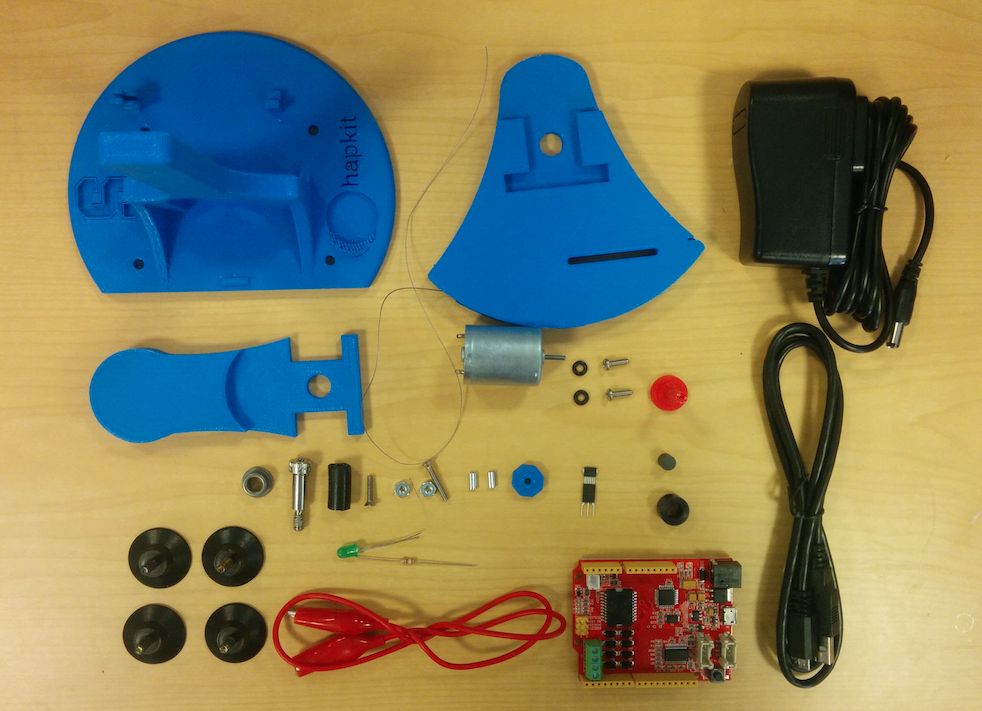
Media-only review: Upstream photograph of Hapkit 3.0 components laid out before assembly (2015 build documentation). Reuse basis: CC-BY-SA-3.0. Inspected the source image, its caption and the actual reuse declaration; no image-specific exception or different credit was found for this selected image. The grant is used only for this media, not as a new hardware/software license. Original image unchanged; displayed responsively. Technical/cost evidence dates unchanged.Revision, date & where cited
Stanford University / Hapkit contributors · hapkit.stanford.edu · Build table: Hapkit 3.0 (3-D printed), 2015 image; image SHA-256 018b79204c3ec3ff644e5c6d5db78be96b15e5db91874a6f30d22f5e336d167d · Accessed Oct 26, 2026
Correction guidance · Discussion is not enabled · Profile format 0.7.0-draft.5
Change history
2026-10-26 — Added attributed upstream media with linked reuse terms; technical evidence dates unchanged.