Maker's Pet Loki
Robot / hardware build200 mm 3D-printable differential-drive pet robot with an ESP32, BLDC gear motors and a choice of hobby LiDARs, run through the shared Kaia.ai ROS 2 stack; sized for common 220 mm-class printers. [1] [8] [9]
Build & first use →Official websiteUpstream build guideBill of materials
- For
- Makers with a 220 × 220 mm or 210 × 250 mm 3D printer who can configure ESP32 firmware, ROS 2 and a hobby LiDAR [1] [9] [15]
- Cost
- USD 66.00 upstream parts estimate [8] · checked Oct 5, 2026 · DetailsNot included: smartphone, PC and 3D printer (listed as bring-your-own), fasteners and wiring not itemized and tax, shipping and handling (stated as extra).
- Source rights
- Named licenses are documented by part. Review licenses
Source researched · Not tested by us
Sources checked · Research details
Licenses & related hardware
Overview
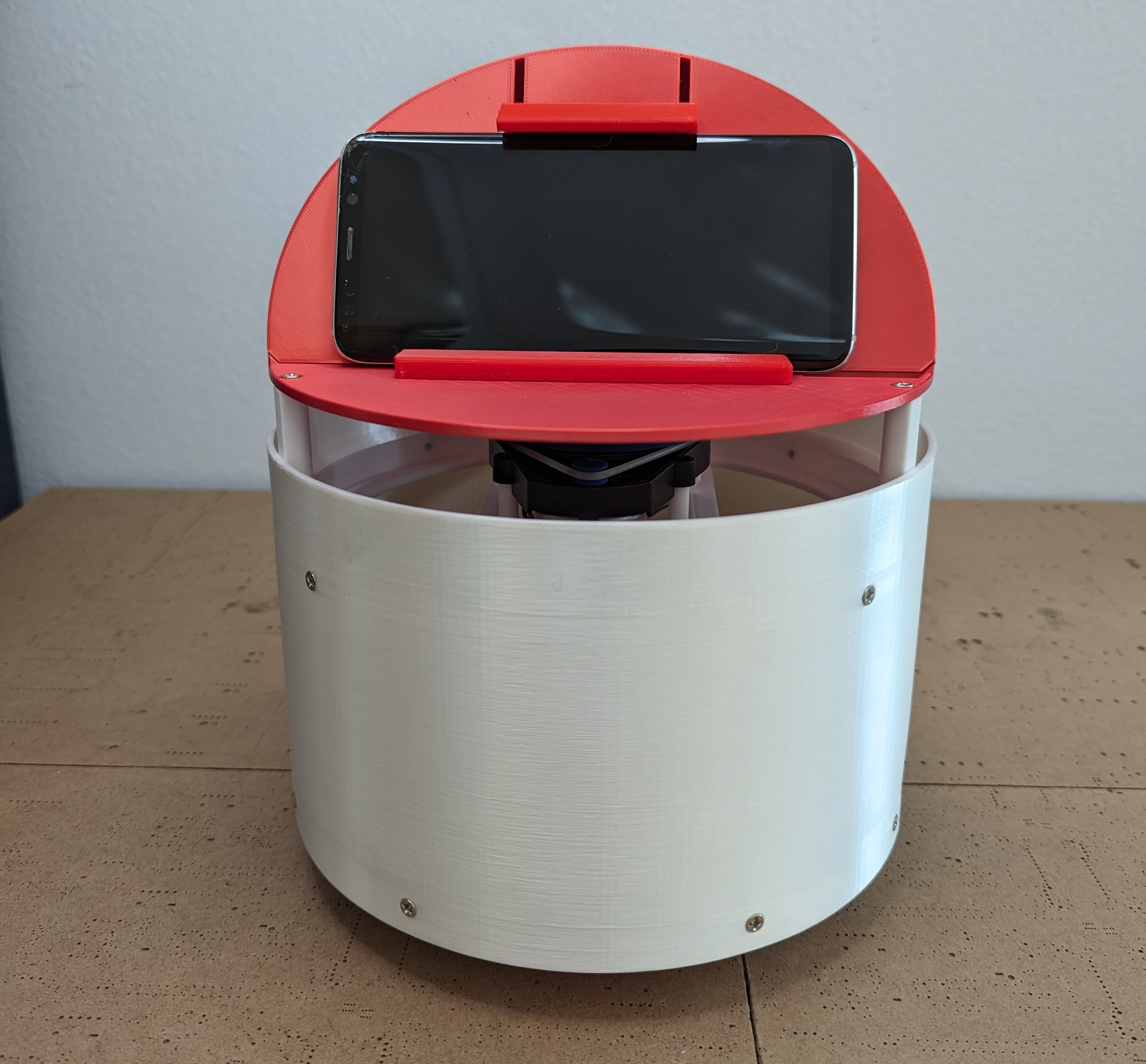
Loki is the 200 mm member of the Maker's Pet pet-robot family: a round, two-wheel differential-drive base with an ESP32, two brushless gear motors and a hobby LiDAR, intended to map rooms and drive itself with ROS 2. The maker sized it for common 210 × 250 mm and 220 × 220 mm print beds and left the bumper off by default to simplify assembly. Pet behaviours were described as waiting on finished software. [1] [9]
Is this for you?
- Use cases
- Room mapping with a 360-degree laser distance sensor
- Autonomous indoor driving
- Modding a ROS 2 robot description for a custom robot
- Known limitations
- Pet character and skills described upstream as work in progress
- No Loki-named board configuration in the pinned shared firmware
- Design source for the ESP32 main board not matched
- Linked CAD repository listed but not preserved (archive over 150 MiB)
- Upstream parts total depends on how two-quantity lines are counted
Source-review boundaries; no hardware tests.
What you need
- Operating system
- Docker on Windows or Linux
- Ubuntu 24.04
Current Kaia.ai platform README; compatibility with this 2025 description snapshot not tested.
- Host computer
ESP32 on the robot; SLAM, Nav2 and Gazebo run on a separate PC. The BOM lists the PC and a smartphone as bring-your-own.
- Dependencies
- kaiaai/firmware ESP32 Arduino micro-ROS firmware
- Arduino libraries micro_ros_kaia, LDS, PID_Timed, ESPAsyncWebSrv (with AsyncTCP, ESPAsyncTCP)
- Kaia.ai ROS 2 packages (kaiaai_bringup, kaiaai_gazebo, kaiaai_teleop)
- Tools
- 3D printer with a 220 × 220 mm or 210 × 250 mm class build volume
- PC for firmware upload and ROS 2
Hardware & parts
Upstream bill of materials [8]
- Hardware configuration
Round two-wheel differential-drive base with a caster, LiDAR plate and a phone handset clamp; no bumper by default.
- Actuators
- Two CHR-GM25-BLDC2418-class 24 V brushless gear motors with built-in controller (BOM page lists several RPM variants)
- Controller
ESP32 (ESP-WROOM-32) on an ESP32 main board with LM2596 24 V-to-5 V regulator
- Sensors
- One supported LiDAR: LDS02RR in the BOM; README also lists YDLIDAR X4/X3/X3-PRO/X2/X2L, Neato XV11 and RPLIDAR A1
- Optional add-on bumper (mod files)
- Power
3 × 9 V alkaline batteries in series in the BOM (about 3 hours of active running per the maker); 16 AA/AAA cells or a 6S1P rechargeable pack listed as alternatives
Assembly & first use
Open the upstream getting-started guide [1] · Project documentation [9]
- Choose a supported LiDAR and print the matching loki_200mm plate with the body parts
- Source the ESP32 board, BLDC motors, LiDAR (plus adapter for LDS02RR) and battery against the dated BOM
- Install the README-listed Arduino libraries, flash the shared Kaia.ai firmware and configure board, motors, LiDAR and WiFi
- Install the Kaia.ai ROS 2 environment and select makerspet_loki
- Try mapping and navigation in Gazebo before the physical robot
Editorial source-navigation sequence, not reproduced instructions.
Cost
| Version | Price |
|---|---|
| Loki 200 mm parts estimate published February 14, 2024 (ESP32 and main board, LDS02RR with adapter, two CHR-GM25-BLDC2418 motors, 3 × 9 V batteries, 0.5 kg filament) | USD 66.00 [8] Parts estimate |
AliExpress/Amazon/eBay examples; destination unspecified · Checked 2026-10-05
| Included | ESP32 and ESP32 main board; 3 × 9 V alkaline batteries with cable; LDS02RR laser scanner with cable and adapter board; Two BLDC motors and 65 mm tires with adapters; 0.5 kg PETG or PLA filament |
|---|---|
| Not included | Smartphone, PC and 3D printer (listed as bring-your-own); Fasteners and wiring not itemized; Tax, shipping and handling (stated as extra) |
| Stock | Prices as of 02/2024; not re-quoted. |
| Delivery and tax | Tax, shipping and handling stated as extra; not quantified. |
Price details
Upstream total $66.00 as of 02/14/2024. The 'Approx. Cost' amounts reach $66 only if the two-quantity motor ($11) and tire ($4) lines are counted once; multiplying by quantity gives $81. The page does not say which applies. Historical estimate, not a current quote.
AliExpress/Amazon/eBay examples; destination unspecified · Checked 2026-10-05 · Quantity 1
Phone, PC, printer, firmware configuration and possibly the per-unit motor/tire difference.
Cost scope
The February 2024 BOM lists an ESP32 and main board, an LDS02RR with adapter, two CHR-GM25-BLDC2418 motors, tires, three 9 V batteries and 0.5 kg of filament, totalling $66.00 with tax and shipping extra. The phone, PC and printer are bring-your-own. The total matches the listed amounts only if the two-motor and two-tire lines are counted once; multiplied by quantity they come to $81. The maker reports about three hours of active running on the 9 V pack. [8]
3D preview
Preview not available yet. Design-source links are available. A configuration-matched assembly and its file-level reuse scope have not yet been reviewed for a hosted preview.
Model sources
Design-source links are available. A configuration-matched assembly and its file-level reuse scope have not yet been reviewed for a hosted preview.
Project notes
How the pieces fit
The pinned makerspet_loki repository is a ROS 2 description package. Its URDF gives a base of about 204 mm, 67 mm wheels and roughly 0.159 m between wheels; its launch guide calls the shared Kaia.ai packages for simulation, mapping and navigation. The ESP32 runs the onboard firmware, while SLAM, Nav2 and Gazebo run on a separate PC. The platform README offers Docker on Windows or Linux and Ubuntu 24.04; that route was not tested with this snapshot. [5] [6] [15]
The printable parts are in makerspet/3d_models. Its listing has separate mounting plates for YDLIDAR X2, X2L, X3 PRO and X4, Neato XV11, RPLIDAR A1 and LDS02RR sensors, plus a 3 × 9 V battery holder, a phone handset clamp and bumper and ear mods. That repository exceeded the catalog's 150 MiB archive limit, so only the file list was preserved. The newest Fusion 360 file is Loki v670, while its README history ends at v669. [10] [18]
Configuration a builder must reconcile
The dated BOM prices an LDS02RR with an adapter board, but the package's telemetry file defaults to a YDLIDAR X4. Choose one sensor, print its plate and set the same model in the firmware and ROS configuration. [7] [8] [10]
The README links the shared kaiaai/firmware code and lists required Arduino libraries. The firmware supports ESC-style BLDC motors, but the board configurations in the pinned snapshot name Mini-family boards and a makerspet_vac board, not Loki. The 2023 Loki page said each design repository included firmware source and KiCad schematics; the pinned Loki repository instead links out to separate repositories. [1] [9] [12] [14]
What we checked
Source research only; no installation, physical build, calibration or test performed. No affiliate links; Maker's Pet store prices on the cited pages were not used as costs.
Updates
- Upstream last updated
- Jan 5, 2025 [2]
- Latest release
- Not established
- Profile updated
- Oct 25, 2026
- Sources last checked
- Oct 5, 2026
- Next review
- Nov 5, 2026
- Reviewed revision
- makerspet/makerspet_loki 253ce286282e437b120afe962078940605e84e3e (commit snapshot 2025-01-05; no published release). Linked CAD makerspet/3d_models 42d7b7956bd6d54b8cff79f26c2f1d54f677ea18 listed only (archive over 150 MiB; latest Fusion file Loki v670); shared firmware kaiaai/firmware e4d159c94321b1431e61f64f12c3a2da24cf2d19 (iron-branch commit snapshot). · software repository
Source files and licenses
Printable CAD, shared firmware, the ROS 2 description and the LDS02RR adapter files are public under Apache-2.0 root licenses; the ESP32 main-board design, a Loki-specific firmware configuration and a current budget remain unresolved.
| Layer | Availability / license |
|---|---|
| mechanical design | available · Apache-2.0 STL and 3MF body parts, per-LiDAR plates, bumper and ear mods, and Fusion 360 archives Loki v550 and v670 are listed at the pinned commit. The Fusion README history ends at v669 while the newest file is v670. Repository archive over the 150 MiB intake limit: files listed, not preserved or opened. Root Apache-2.0 as declared; purchased parts not covered. [10] [11] [18] |
| electronics | available · Apache-2.0 Partial: the LDS02RR adapter (v0.3.0) has a schematic PDF, BOM CSV and Gerber archive in makerspet/store, the repository the README PCB link now resolves to. No editable KiCad project, and no design source matched to the ESP32 main board in the BOM, was identified. [8] [9] [16] [17] |
| firmware | available · Apache-2.0 (root); bundled LGPL-3.0 and GPL-3.0 libraries Shared platform firmware. Root Apache-2.0; README-required PID_Timed carries a GPL-3.0 file and AsyncTCP/ESPAsyncWebSrv LGPL-3.0 files. Pinned board configurations name Mini-family boards and a makerspet_vac BLDC board, none for Loki. [1] [12] [13] [14] |
| software | available · Apache-2.0 ROS 2 description package (URDF, SDF mesh, Nav2/Cartographer configuration). Runtime packages live in separate Kaia.ai repositories whose licenses were not individually reviewed. [1] [3] [4] [15] |
| documentation | available · Apache-2.0 Repository README under the root license. Maker's Pet blog pages and linked videos show no separate license in the inspected text; videos were not reviewed. [1] [3] [8] [9] |
Selected mapping and navigation workflow uses no learned model weights.
No dataset is part of the selected workflow.
Licenses and unknowns
The description package, CAD repository and makerspet/store files carry Apache-2.0 license files. The store holds the LDS02RR adapter schematic, BOM and Gerbers, but no design source matched to the ESP32 main board was identified. The firmware's root license is Apache-2.0, while the README-required PID_Timed library carries a GPL-3.0 file and AsyncTCP and ESPAsyncWebSrv carry LGPL-3.0 files. Nothing was compiled, printed, assembled or tested for this profile. [3] [11] [13] [16] [17]
References
Each source links to the exact revision we read. “Used for” shows where this page relies on it.
- S001 Maker's Pet Loki README
Robot description, features, linked CAD/firmware/PCB repositories, setup videos and support forum.Revision, date & where cited
Maker's Pet (makerspet.com) · github.com · revision
253ce28· README.md at · Accessed Oct 5, 2026
Used for: Overview, Is this for you?, What you need, Hardware & parts and 3 more - S002 Repository revision and popularity metadata
Selected default-branch commit snapshot (no published release), commit date, archive checksum and dated repository-level popularity.Revision, date & where cited
Maker's Pet (makerspet.com) · github.com · revision
253ce28· ; GitHub repository and commit API fields · Accessed Oct 5, 2026
Used for: What we checked - S003 makerspet/makerspet_loki: LICENSE
Revision, date & where cited
Maker's Pet (makerspet.com) · github.com · revision
253ce28· Accessed Oct 5, 2026
Used for: Source files and licenses - S004 ROS 2 package manifest
Package name, description, maintainer and declared Apache 2.0 license.Revision, date & where cited
Maker's Pet (makerspet.com) · github.com · revision
253ce28· Accessed Oct 5, 2026
Used for: Source files and licenses - S005 Robot URDF dimensions
Simulation/description dimensions: base diameter, wheel diameter, wheel separation and tablet head geometry.Revision, date & where cited
Maker's Pet (makerspet.com) · github.com · revision
253ce28· urdf/robot.urdf.xacro, ROBOT DIMENSIONS block · Accessed Oct 5, 2026
Used for: Hardware & parts, How the pieces fit - S006 Robot description modding and command guide
kaiaai_bringup/kaiaai_gazebo launch commands for physical, simulated, mapping and navigation runs.Revision, date & where cited
Maker's Pet (makerspet.com) · github.com · revision
253ce28· Accessed Oct 5, 2026
Used for: Is this for you?, What you need, Assembly & first use, How the pieces fit - S007 Telemetry configuration
Default LiDAR model and scan mask radius for the description package.Revision, date & where cited
Maker's Pet (makerspet.com) · github.com · revision
253ce28· Accessed Oct 5, 2026
Used for: Hardware & parts, Configuration a builder must reconcile - S008 Maker's Pet bill-of-materials page
Dated parts list and upstream parts total with bring-your-own exclusions.Revision, date & where cited
Maker's Pet (Ilia O.) · makerspet.com · Blog page snapshot sha256 1e7202bfb229 · Accessed Oct 5, 2026
Used for: Is this for you?, What you need, Hardware & parts, Assembly & first use and 3 more - S009 Maker's Pet robot design page
Design notes, print-volume requirement, development status and repository contents as described by the maker.Revision, date & where cited
Maker's Pet (Ilia O.) · makerspet.com · Blog page snapshot sha256 1533ef11db08 · Accessed Oct 5, 2026
Used for: Overview, Is this for you?, What you need, Hardware & parts and 3 more - S010 Linked CAD repository file listing (makerspet/3d_models)
STL, 3MF and Fusion 360 file names and sizes for the model; no geometry inspected.Revision, date & where cited
Maker's Pet (makerspet.com) · github.com · revision
42d7b79· Git tree API listing at ; repository archive over the 150 MiB intake limit, files listed but not preserved · Accessed Oct 5, 2026
Used for: Is this for you?, Hardware & parts, Assembly & first use, How the pieces fit and 2 more - S011 Linked CAD repository license
Apache License 2.0 text for the CAD repository.Revision, date & where cited
Maker's Pet (makerspet.com) · github.com · revision
42d7b79· LICENSE at the pinned CAD commit · Accessed Oct 5, 2026
Used for: Source files and licenses - S012 Kaia.ai platform firmware README
Shared ESP32 Arduino/micro-ROS firmware: supported motor drivers, BLDC motor guidance and change log.Revision, date & where cited
Kaia.ai / Maker's Pet contributors · github.com · revision
e4d159c· README.md at (iron branch snapshot) · Accessed Oct 5, 2026
Used for: What you need, Assembly & first use, Configuration a builder must reconcile, Source files and licenses - S013 Firmware and bundled library license files
Root Apache-2.0 plus bundled libraries under Apache-2.0, LGPL-3.0 and GPL-3.0 license files.Revision, date & where cited
Kaia.ai / Maker's Pet contributors · github.com · revision
e4d159c· LICENSE and libraries/*/LICENSE headers · Accessed Oct 5, 2026
Used for: Source files and licenses - S014 Firmware board configuration files
Board configurations shipped with the pinned firmware snapshot.Revision, date & where cited
Kaia.ai / Maker's Pet contributors · github.com · revision
e4d159c· kaiaai-esp32/data/*.yaml board model lines · Accessed Oct 5, 2026
Used for: Is this for you?, Configuration a builder must reconcile, Source files and licenses - S015 Kaia.ai ROS 2 package README
Platform architecture (ESP32 on robot, ROS 2 on PC), compatible robot list, supported LiDARs and installation routes.Revision, date & where cited
Kaia.ai / Maker's Pet contributors · github.com · revision
ef5fb2a· README.md at · Accessed Oct 5, 2026
Used for: What you need, Assembly & first use, How the pieces fit, Source files and licenses - S016 Maker's Pet store technical files inventory
Schematic PDFs, STEP models, one Gerber archive and board configs; no editable KiCad project identified.Revision, date & where cited
Maker's Pet (makerspet.com) · github.com · revision
e338516· archive file inventory · Accessed Oct 5, 2026
Used for: Source files and licenses - S017 Redirect of the README-linked PCB repository
The README-linked makerspet/pcb repository resolves to makerspet/store.Revision, date & where cited
Maker's Pet (makerspet.com) · github.com · GitHub API repos/makerspet/pcb response (redirected) · Accessed Oct 5, 2026
Used for: Source files and licenses - S018 Loki Fusion 360 design README
Fusion 360 opening/export instructions and design release history.Revision, date & where cited
Maker's Pet (makerspet.com) · github.com · revision
42d7b79· loki_200mm/fusion360/README.md at the pinned CAD commit · Accessed Oct 5, 2026
Used for: How the pieces fit, Source files and licenses - S019 Upstream image and reuse attribution
Media-only review: Upstream photograph of the MakersPet Loki robot enclosure and sensor configuration. Reuse basis: Apache-2.0; inspected LICENSE and the pinned file inventory for nearer notices. Original image unchanged; displayed responsively. This does not refresh technical or cost evidence.Revision, date & where cited
MakersPet contributors · github.com · Image SHA-256 78d15a6ea2c4feefd0d1663e9f500863ea119001deb8cc41728fcd9ba172579c; repository · Accessed Oct 25, 2026
Correction guidance · Discussion is not enabled · Profile format 0.7.0-draft.5
Change history
2026-10-05 — Initial intake profile from pinned upstream sources (Growbotics lead verified against upstream).
2026-10-25 — Added an attributed upstream image with linked reuse terms; technical evidence dates unchanged.