Mobile ALOHA
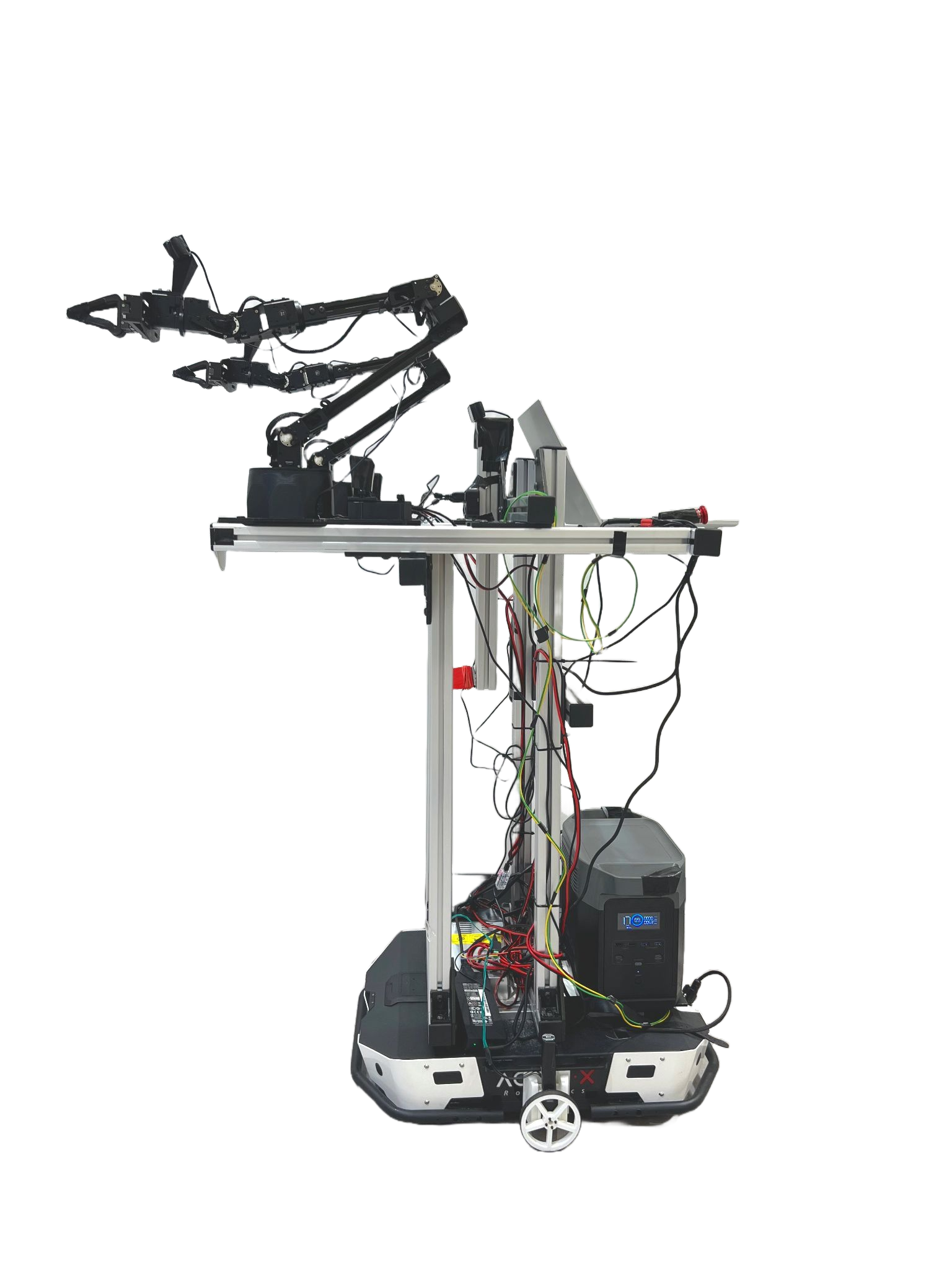
Robot / hardware buildHardware-and-software platform combining two leader arms, two follower arms and an AgileX Tracer base for whole-body teleoperation and demonstration collection. [1] [9]
Build & first use →Official websiteUpstream build guideBill of materials
- For
- Research teams able to integrate commercial robot arms, a mobile base and ROS 1 devices [1]
- Cost
- USD 31,757.86 upstream parts estimate [9] · checked Oct 4, 2026 · DetailsNot included: shipping and destination taxes, labor and priced allowance for Allen keys and hot glue gun and more.
- Source rights
- Some licenses are unresolved. Review licenses
Source researched · Not tested by us
Sources checked · Research details
Licenses & related hardware
- License
- MIT · license not fully assessed for mechanical design · Details by part
Overview
Mobile ALOHA is a hardware-and-software system integrating two leader arms, two follower arms and an AgileX Tracer base for bimanual mobile manipulation. This profile selects the physical build documented in the project tutorial together with the teleoperation and data-collection repository. Its default launch configuration uses Interbotix wx250s leader models and vx300s follower models. Imitation-learning training is delegated to the separate ACT for Mobile ALOHA repository. [1] [5] [9]
Is this for you?
- Known limitations
- ROS 2 and Ubuntu 22.04 or newer are still compatibility work in the preserved README
- Base velocity recording uses a separate wheel device path
- The tutorial BOM lists four webcams, while the reviewed launch file actively starts three and comments out the low camera
- The project-reported BOM total is historical and was not refreshed as a delivered quote
- No trained policy or reproduction result reviewed
What you need
- Operating system
- Ubuntu 20.04 with ROS 1 Noetic, selected from upstream reported configurations
Upstream also reports Ubuntu 18.04 with Noetic; no system installation verified here.
- Host computer
Computer connected to four arms over USB, three cameras and the Tracer CAN-to-USB interface.
- Dependencies
- ROS 1 Noetic and Interbotix software
- usb_cam and cv_bridge
- pyagxrobots and CAN interface
- Python 3.8.10 environment with unpinned dependencies
- Separate ACT for Mobile ALOHA repository for imitation learning
- Tools
- Allen keys
- Hot glue gun
Listed as common equipment without prices in the tutorial BOM.
Hardware & parts
Upstream bill of materials [9]
- Actuators
- Two Interbotix wx250s leader arms
- Two Interbotix vx300s follower arms
- AgileX Tracer mobile base
- Sensors
- High camera and two wrist cameras in the active launch file
- Arm joint state feedback
- Separate Dynamixel wheel-velocity interface in the recorded base observation path
- Power
Tutorial BOM specifies a battery pack, 600 W DC supply, five 12 V DC cables and fork spade connectors.
Assembly & first use
Open the upstream getting-started guide [9] · Project documentation [1]
- Assembly
The first-party tutorial documents frame, leader/follower arm, camera and counterbalance assembly, links project CAD, and identifies six wheel-odometry printed pieces. End-effector printing follows the original ALOHA tutorial.
- Calibration
Map each arm and camera to persistent device names; match gripper limits and start poses to the selected hardware.
Documented commissioning requirements, not performed.
Cost
| Version | Price |
|---|---|
| Mobile ALOHA tutorial build with four arms, mobile base and onboard computer | USD 31757.86 [9] Parts estimate |
US-linked supplier examples; destination unspecified · Checked 2026-10-04
| Included | Two ViperX 300 follower arms; Two WidowX 250 leader arms; AgileX Tracer AGV; Lambda Labs Tensorbook; 4040 aluminum frame and connectors; Four Logitech C922x webcams and two USB hubs; Battery and 600 W DC power hardware; Two-wheel Dynamixel odometry hardware; Miscellaneous gripping materials |
|---|---|
| Not included | Shipping and destination taxes; Labor; Priced allowance for Allen keys and hot glue gun; Confirmed current cost for the malformed weights row; 3D printing service, material and printer unless already available |
| Stock | Historical links and prices were not rechecked for current stock. |
| Delivery and tax | Not stated; no destination-specific delivered total. |
Price details
Project-reported tutorial total from a document last modified in 2024; vendor prices, stock and package sizes were not refreshed. The weights price cell is malformed, common tools are unpriced, and the four-camera BOM differs from the three cameras active in the reviewed launch file.
US-linked supplier examples; destination unspecified · Checked 2026-10-04 · Quantity 1
Reconcile the tutorial’s four-camera BOM with the three-camera active launch configuration; source or print the documented end-effector and wheel-odometry parts.
3D preview
Preview not available yet. Design-source links are available, but the reviewed record does not establish unambiguous reuse rights for a hosted CAD preview.
Model sources
Design-source links are available, but the reviewed record does not establish unambiguous reuse rights for a hosted CAD preview.
Project notes
Reproduce the selected device arrangement
The README describes persistent USB device names for all four arms and three cameras, plus the Tracer's CAN-to-USB connection. The active launch file starts the high camera and two wrist cameras; a fourth low-camera block is commented out. The overview's reference to four cameras should therefore not be read as the active launch configuration. [1] [5]
The guide discourages USB hubs for the arms and limits camera sharing per hub to manage latency. It also notes that Dynamixel Wizard and other camera applications must release devices before the ROS processes connect. Those are configuration requirements from upstream, not proof that an arbitrary computer and USB arrangement will sustain recording. [1]
The project tutorial provides the hardware bill of materials, links the project CAD, identifies six wheel-odometry print pieces and walks through frame, arm, camera and counterbalance assembly. Its BOM reports a total of $31,757.86 for two ViperX 300 follower arms, two WidowX 250 leader arms, the Tracer base, a Tensorbook, frame parts, cameras, power hardware and wheel odometry. This is a historical project-reported total from a document last modified in 2024, not a current delivered quote: shipping, tax and labor are not resolved, common tools have no prices, and the weights row contains malformed price text. [9]
The tutorial BOM lists four Logitech webcams, while the reviewed launch file actively starts three cameras and leaves a fourth low-camera block commented out. Treat the BOM as the documented physical build and reconcile that camera difference before purchasing. The repository's MIT license covers its code and included files; it does not automatically set the terms for purchased arms, the mobile base or externally linked CAD. [3] [5] [9]
Use a defined ROS and Python environment
The preserved guide reports Ubuntu 20.04 with ROS 1 Noetic as a working configuration; this profile selects that route. ROS 2 and newer Ubuntu versions remain compatibility work in that README. The installation also instructs a local edit to Interbotix code to avoid repeated forward-kinematics computation during position publication. Preserve that edit and the actual dependency revision when recreating the setup. [1]
The Python environment starts from Python 3.8.10 but installs several packages without pinned versions. This archive is therefore not a complete reproducible environment. No dependencies were installed and no hardware commands were executed for this review. [1] [2]
Recorded base action is derived from observations
The episode recorder stores arm observations, images, arm actions and a two-value base_action field. In this revision, base_action is populated from the environment's base_vel observation. That observation reads a separate Dynamixel client at /dev/ttyDXL_wheels, with IDs 1 and 2 and fixed wheel geometry, then derives linear and angular velocity. It is not simply copied from a commanded Tracer velocity. [6] [7]
This creates an additional reproduction requirement beyond bringing up the Tracer CAN interface: the selected wheel-feedback device, mapping and geometry must agree with the recording code. The environment contains a separate Tracer velocity getter, but the default base observation follows the Dynamixel path. No claim is made that this feedback configuration was assembled or verified here. [7]
The recording loop targets 50 FPS. Recollection is triggered when a processing-frequency diagnostic falls below 30 Hz; that diagnostic excludes loop sleep and does not measure the complete recording cadence. Its image path compresses images before saving. These implementation details matter when interpreting saved episodes; merely finding an HDF5 file does not establish correctly synchronized or sufficiently fast data capture. [6] [8]
Teleoperation is not a trained policy result
The README recording example uses --dataset_dir, but the reviewed recorder requires --task_name and reads its output directory, episode length and camera names from TASK_CONFIGS in aloha_scripts/constants.py. Select and reconcile that configuration before invoking record_episodes.py with --task_name. This is a code-derived correction to an inconsistent example, not a verified working procedure. [1] [6] [8]
The README's basic one-side teleoperation example does not collect data; episode recording and replay are separate programs. Upstream also instructs users to start from the sleep pose and notes that the arms lack automatically engaged joint brakes when torque is removed. Follow the selected hardware's setup and shutdown procedure before attempting those programs. [1]
This profile covers the available integration code, not a pretrained policy, released dataset or verified learning result. No installation, device setup, arm motion, mobile driving, recording or replay was performed. [1] [3] [4]
What we checked
Source research only; no installation, physical build or performance test performed. No affiliate links added.
Not yet established
- A step-by-step setup summary
Updates
- Upstream last updated
- Jan 3, 2024 [2]
- Latest release
- Not established
- Profile updated
- Oct 26, 2026
- Sources last checked
- Oct 4, 2026
- Next review
- Nov 3, 2026
- Reviewed revision
- 0e403249c76054a68e757e590d4da4dba401c9e3 (commit snapshot; no published stable release found) · combined hardware and software repository
Source files and licenses
Available project sources support research coverage; complete build and commercial qualification remain separate.
| Layer | Availability / license |
|---|---|
| mechanical design | available · License not fully assessed The first-party tutorial links a project CAD model and wheel-odometry print files, but does not state a license for the externally hosted CAD. Availability does not establish manufacturing or redistribution permission. [9] |
| electronics | not found · License not fully assessed Complete matching source for this layer not established in the selected integration-code archive; external assembly tutorial and purchased components need separate review. [1] [4] |
| firmware | not found · License not fully assessed Complete matching source for this layer not established in the selected integration-code archive; external assembly tutorial and purchased components need separate review. [1] [4] |
| software | available · MIT Selected repository software and documentation; commercial hardware and external packages retain separate terms. [1] [3] [4] |
| documentation | available · MIT Selected repository software and documentation; commercial hardware and external packages retain separate terms. [1] [3] [4] |
Selected teleoperation and new episode-recording route requires no pretrained policy or existing dataset. Training is a separate repository and workflow.
References
Each source links to the exact revision we read. “Used for” shows where this page relies on it.
- S001 MarkFzp/mobile-aloha: README.md
Revision, date & where cited
github.com · revision
0e40324· Accessed Oct 1, 2026
Used for: Overview, Is this for you?, What you need, Hardware & parts and 5 more - S002 MarkFzp/mobile-aloha: commit 0e40324
Revision, date & where cited
github.com · Accessed Oct 1, 2026
Used for: Use a defined ROS and Python environment, What we checked - S003 MarkFzp/mobile-aloha: LICENSE
Revision, date & where cited
github.com · revision
0e40324· Accessed Oct 1, 2026
Used for: Reproduce the selected device arrangement, Teleoperation is not a trained policy result, Source files and licenses - S004 MarkFzp/mobile-aloha: files
Revision, date & where cited
github.com · revision
0e40324· archive file inventory · Accessed Oct 1, 2026
Used for: Teleoperation is not a trained policy result, Source files and licenses - S005 Mobile ALOHA: launch/4arms_teleop.launch
Revision, date & where cited
github.com · revision
0e40324· Accessed Oct 1, 2026
Used for: Overview, Is this for you?, Hardware & parts, Reproduce the selected device arrangement - S006 Mobile ALOHA: aloha_scripts/record_episodes.py
Revision, date & where cited
github.com · revision
0e40324· Accessed Oct 1, 2026
Used for: Is this for you?, Hardware & parts, Recorded base action is derived from observations, Teleoperation is not a trained policy result - S007 Mobile ALOHA: aloha_scripts/real_env.py
Revision, date & where cited
github.com · revision
0e40324· Accessed Oct 1, 2026
Used for: Is this for you?, Hardware & parts, Recorded base action is derived from observations - S008 Mobile ALOHA: aloha_scripts/constants.py
Revision, date & where cited
github.com · revision
0e40324· Accessed Oct 1, 2026
Used for: Recorded base action is derived from observations, Teleoperation is not a trained policy result - S009 Mobile ALOHA hardware assembly tutorial and bill of materials
The tutorial links the project CAD, documents hardware assembly, lists two ViperX 300 arms, two WidowX 250 arms, one Tracer AGV, compute, frame, cameras, power and wheel odometry, and reports a $31,757.86 total. The total is historical; one weights price cell is malformed and common tools are unpriced.Revision, date & where cited
Zipeng Fu, Tony Zhao and Chelsea Finn / Stanford University · docs.google.com · Our CAD; Bill of Materials; 3D Printed Parts; Hardware Guide · Accessed Oct 4, 2026
Used for: Overview, Is this for you?, What you need, Hardware & parts and 4 more - S010 Upstream image and reuse attribution
Media-only review: Upstream paper photograph of Mobile ALOHA with its teleoperation hardware (Figure 2, left view). Reuse basis: CC-BY-4.0. Inspected the source image, its caption and the actual reuse declaration; no image-specific exception or different credit was found for this selected image. The grant is used only for this media, not as a new hardware/software license. Embedded image extracted from page 3 of the source PDF and losslessly decoded to PNG; no retouching. Technical/cost evidence dates unchanged.Revision, date & where cited
Zipeng Fu, Tony Z. Zhao and Chelsea Finn · proceedings.mlr.press · Published PMLR paper Figure 2 left / page 3; image SHA-256 9a7b53403d9190752ce2d5eb50ac1105d6e3c6fea216db4915e0d8c9138ccfa0 · Accessed Oct 26, 2026
Correction guidance · Discussion is not enabled · Profile format 0.6.0-draft.1
Change history
2026-10-04 — Added the first-party hardware assembly tutorial, project CAD link and reported $31,757.86 BOM; documented the tutorial/launch camera-count difference.
2026-10-26 — Added attributed upstream media with linked reuse terms; technical evidence dates unchanged.