ROSMO
Robot / hardware buildSmall modular robot with a PCB chassis, ESP32-S3 and two- or four-wheel variants; separate Microblocks, MicroPython and ROS 2 routes have different maturity. [5] [6] [7]
Build & first use →Official websiteBill of materials
- For
- Students and experienced hobbyists able to reconcile hardware variants and developing software [1]
- Cost
- No current cost yet. Upstream bill of materials [5]
- Source rights
- Some licenses are unresolved. Review licenses
- Unknowns
- tools, operating system not fully established. Review gaps
Source researched · Not tested by us
Sources checked · Research details

Licenses & related hardware
- License
- Apache-2.0, CC-BY-4.0 · license not fully assessed for mechanical design · Details by part
Overview
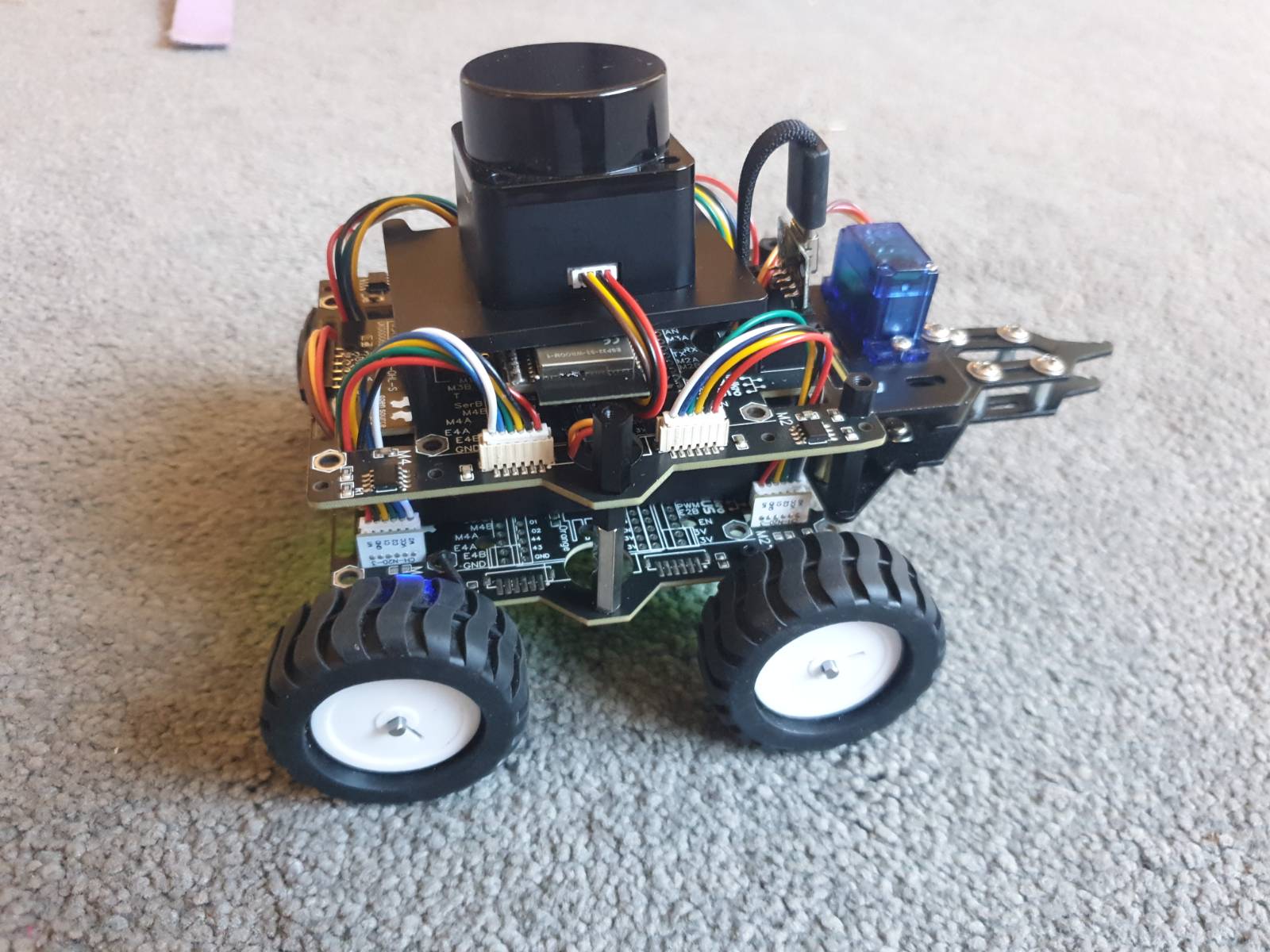
ROSMO is a small mobile robot built around an ESP32-S3 and a two-plate PCB chassis. The official parts guide offers two- and four-wheel configurations using 6 V, 150 RPM geared motors with encoders. It recommends an Olimex ESP32-S3 board but lists alternatives; those alternatives should not be treated as identical electrical or assembly configurations. [5] [6]
Is this for you?
- Known limitations
- Upstream reports flaky I2C and incomplete testing
- ROS 2 guide names a configuration file absent from the selected companion revision
- Selected rosmo build flag lacks a matching include in config/config.h
- Complete EasyEDA PCB source and release matching remain unresolved
3D preview
ROSMO four-wheel robot from the project FreeCAD file (CROSS robot rosmo). The four-wheel ROSMO robot as modeled in the project FreeCAD file cad/rosmo_robot.FCStd at commit c460b0a: its CROSS robot description named rosmo, with the chassis, lidar and four wheel links (frw, flw, brw, blw), each shown with the placement of its source link at zero joint positions. The chassis link holds the PCB chassis body rosmo_board and an ESP32-S3-WROOM module model (131 bodies), the lidar link holds an LD19 lidar model (8 bodies) and each wheel link holds the same wheel body: 144 bodies. The two-wheel variant described in this profile is not shown, and motors, battery and wiring do not appear as separate parts. The ESP32-S3-WROOM and LD19 models are third-party component models kept as placed; their terms are unknown. The repository LICENSE is Apache-2.0 but the file metadata says All rights reserved, so no manufacturing or redistribution clearance is claimed. Fit and function are not verified.
Conflicting license notices: the rosmo-firmware repository LICENSE is the Apache License, Version 2.0, but the metadata of the CAD file rosmo_robot.FCStd itself says “All rights reserved” (license URL http://en.wikipedia.org/wiki/All_rights_reserved), with the author and company fields left empty. That is the value FreeCAD fills in for new documents unless another license is chosen, and the repository gives no CAD-specific license, so it is unclear which notice applies to the file. Open Source Robotics shows the model for reference under the user decision of October 4, 2026 and claims no manufacturing, redistribution or other clearance. The ESP32-S3-WROOM module and LD19 lidar models inside the file are third-party component models; their terms are unknown. License: rosmo-firmware LICENSE (Apache-2.0); FCStd metadata All rights reserved · upstream notice.
The 3D preview loads after the page.
Drag to orbit · Scroll or pinch to zoom · Right-drag to pan. Use the view buttons for front, side and top views. The tree shows names supplied by the source; unnamed bodies remain labeled as such.
Download original FreeCAD FCStd (unchanged) · File checksums and provenance
Separate bodies can be inspected in the model tree. Explode is a viewing aid, not an assembly sequence.
Model sources
The preview uses the linked original design. Source grouping is retained where present; the caption identifies whether this is an assembly or one component.
Source, license and scale
Source: ROSMO project (rosmo-robot), revision c460b0a013ec389b9da98feffd75d22b357534a7. Original and preview: Apache-2.0 (repository) vs All rights reserved (FCStd metadata). Preview conversion by Open Source Robotics; original file unchanged. Preview coordinates are centered and rounded to six decimal places. Each body is the BREP shape embedded in the FreeCAD file, triangulated in millimetres and placed by the source App::Link placement of its robot link composed with the nested App::Part placements of the source file (the BREP already carries its own object placement, which is not applied twice); joint positions are zero in the source. No physical part tested.
Viewer: three-cad-viewer 5.0.7 (MIT license). Confirm scale and manufacturing settings before printing.
What you need
Hardware & parts
Assembly & first use
Cost
No current, complete configuration-specific build cost has been established for this profile.
Project notes
A PCB chassis reduces printing requirements
The assembly guide places the battery between the two plates, mounts motors with their encoder connectors facing inward and upward, and connects components through headers. The standard chassis is intended to avoid a soldering or 3D-printing requirement, while optional attachments can be printed. Board orientation and motor direction still need checking during assembly. No robot was assembled in this review. [5] [6]
The website gives rough US-dollar estimates of $50 for two-wheel drive and $80 for four-wheel drive. These are upstream estimates, not current delivered offers; optional sensors, regional sourcing and a complete matched configuration remain unresolved. The page itself reports flaky I2C, so its expansion list is not proof that every listed sensor combination works reliably. [5]
Software choices are at different stages
The official software page reports working Microblocks control with encoders not yet configured, a MicroPython beta with an encoder-based driving interface, and ROS 2 wheels and encoders working but not fully tested. Its OpenBot option still needs ESP32-S3 changes. These statements describe separate routes; they do not establish a single interchangeable or fully tested software stack. [7]
The primary firmware archive is a derivative of Linorobot2 hardware code. The website's ROS 2 instructions point to a different repository, rosmo-robot/linorobot2_hardware. This review preserved that companion at commit 33f139ad7e0ba15ce135f8cfa331794a339fc10f and compared its configuration with the guide. The two repositories are not presented as a validated revision pair. [1] [8] [9] [10]
Reconcile the ROS 2 configuration before building
The guide tells readers to edit config/custom/rosmo_config.h. The selected companion instead contains rosmo_wifi_config.h. Its PlatformIO rosmo environment defines USE_ROSMO_WIFI_CONFIG, but config/config.h has no matching include and falls back to lino_base_config.h when no base is defined. The presence of a ROSMO-named header therefore does not establish that this build environment selects it. [7] [8] [9] [10]
That custom header selects four-wheel skid steer, 1050 encoder counts per revolution, a 40 mm wheel diameter and a 105 mm left-to-right wheel distance. It also supplies motor inversion, encoder inversion, pins, agent address and port 8888. Preserve and reconcile those source values with the actual chassis rather than applying them automatically to a two-wheel build. The Wi-Fi access-point initializer also contains an extra comma between entries. These are source-inspection findings; no compilation or network test was performed. [9]
The guide uses a Humble Docker environment, while PlatformIO pulls several libraries without exact revisions. A tested setup would require both the configuration-selection issue and the dependency versions to be resolved. This profile does not provide a verified replacement command sequence. [7] [8] [10]
What we checked
Source research only; no installation, physical build or performance test performed. No affiliate links added.
Not yet established
- Requirements: operating system, tools
- A step-by-step setup summary
Updates
- Upstream last updated
- Sep 22, 2025 [2]
- Latest release
- Not established
- Profile updated
- Oct 25, 2026
- Sources last checked
- Oct 1, 2026
- Next review
- Oct 31, 2026
- Reviewed revision
- c460b0a013ec389b9da98feffd75d22b357534a7 (commit snapshot; no published stable release found) · combined hardware and software repository
Source files and licenses
Available project sources support research coverage; complete build and commercial qualification remain separate.
| Layer | Availability / license |
|---|---|
| mechanical design | available · License not fully assessed FreeCAD file preserved; its completeness, matching PCB revision and specific hardware-license mapping have not been established. [12] |
| electronics | not found · License not fully assessed Official website links EasyEDA designs and states PCB CERN-OHL-S; complete matching editable payload and exact license version were not preserved in this review. [5] |
| firmware | available · Apache-2.0 Primary firmware source available; linked companion is separate and its selected ROSMO configuration has unresolved integration issues. External dependencies retain their own terms. [1] [3] [4] |
| software | available · Apache-2.0 Primary firmware source available; linked companion is separate and its selected ROSMO configuration has unresolved integration issues. External dependencies retain their own terms. [1] [3] [4] |
| documentation | available · CC-BY-4.0 Website declares documentation CC-BY-4.0 unless otherwise noted; repository documentation follows its own notices. [5] [6] [7] |
Selected basic driving and programming workflows do not require a pretrained policy or dataset.
Source availability is split across layers
The primary archive includes a FreeCAD file, and both inspected firmware repositories carry Apache 2.0 license texts. The official website separately states CERN-OHL-S for the PCB and CC-BY-4.0 for its documentation unless otherwise noted. Its EasyEDA links were identified, but the complete editable PCB payload, exact hardware-license version and correspondence to the preserved FreeCAD model remain unresolved. Repository software licensing is not treated as a blanket license for that hardware set. No fabrication, firmware installation, driving or sensor test was performed. [3] [5] [11] [12]
References
Each source links to the exact revision we read. “Used for” shows where this page relies on it.
Project sources
- S001 rosmo-robot/rosmo-firmware: README.md
Revision, date & where cited
github.com · revision
c460b0a· Accessed Oct 1, 2026
Used for: Assembly & first use, Software choices are at different stages, Source files and licenses - S002 rosmo-robot/rosmo-firmware: commit c460b0a
- S003 rosmo-robot/rosmo-firmware: LICENSE
Revision, date & where cited
github.com · revision
c460b0a· Accessed Oct 1, 2026
Used for: Source files and licenses - S004 rosmo-robot/rosmo-firmware: files
Revision, date & where cited
github.com · revision
c460b0a· archive file inventory · Accessed Oct 1, 2026
Used for: Source files and licenses - S005 ROSMO official hardware
Revision, date & where cited
rosmo-robot / project contributors · rosmo-robot.github.io · Preserved website snapshot 9cac5e6d04c951500f4e7095e2a386d639c250fea201c9762d04b0c7076562e5 · Accessed Oct 1, 2026
Used for: Overview, Is this for you?, Hardware & parts, Assembly & first use and 2 more - S006 ROSMO official build
Revision, date & where cited
rosmo-robot / project contributors · rosmo-robot.github.io · Preserved website snapshot fe2f968ec97a4911c0891858dc2a9f9e72725cda5522976c0481698036ced68e · Accessed Oct 1, 2026
Used for: Overview, Hardware & parts, Assembly & first use, A PCB chassis reduces printing requirements and 1 more - S007 ROSMO official software
Revision, date & where cited
rosmo-robot / project contributors · rosmo-robot.github.io · Preserved website snapshot 854c190cb885e0662bde004ca6f853ab33b8df38df50899f3e3d2067da7feda3 · Accessed Oct 1, 2026
Used for: Is this for you?, What you need, Hardware & parts, Software choices are at different stages and 2 more - S008 ROSMO companion: firmware/platformio.ini
Revision, date & where cited
github.com · revision
33f139a· Accessed Oct 1, 2026
Used for: Is this for you?, What you need, Assembly & first use, Software choices are at different stages and 1 more - S009 ROSMO companion: config/custom/rosmo_wifi_config.h
Revision, date & where cited
github.com · revision
33f139a· Accessed Oct 1, 2026
Used for: Is this for you?, Assembly & first use, Software choices are at different stages, Reconcile the ROS 2 configuration before building - S010 ROSMO companion: config/config.h
Revision, date & where cited
github.com · revision
33f139a· Accessed Oct 1, 2026
Used for: Is this for you?, Assembly & first use, Software choices are at different stages, Reconcile the ROS 2 configuration before building - S011 ROSMO companion: LICENSE
Revision, date & where cited
github.com · revision
33f139a· Accessed Oct 1, 2026
Used for: Source files and licenses - S012 Preserved primary source inventory
Revision, date & where cited
github.com · revision
c460b0a· file inventory · Accessed Oct 1, 2026
Used for: Source files and licenses - S014 Upstream image and reuse attribution
Media-only review: Upstream photograph of a Rosmo wheeled robot configuration; pictured accessories and board revisions can differ from other builds. Reuse basis: CC-BY-4.0; inspected the published page, image caption and reuse footer; no image-specific exception found for this selected image. Original image unchanged; displayed responsively. This does not refresh technical or cost evidence.Revision, date & where cited
Rosmo Robot contributors · rosmo-robot.github.io · Image SHA-256 a69f8a9f14d25ccacfea8f5bd0d24725e6fc5c765d4dc4df79e0cbe193a34d86; source revision page SHA-256 9cac5e6d04c951500f4e7095e2a386d639c250fea201c9762d04b0c7076562e5 · Accessed Oct 25, 2026
Videos
- S013 Rosmo Robot (YouTube channel)
The project’s own YouTube channel, linked from the project’s own documentation. Not reviewed by us for accuracy.Revision, date & where cited
YouTube channel Rosmo Robot · youtube.com · Accessed Oct 4, 2026
Correction guidance · Discussion is not enabled · Profile format 0.6.0-draft.1
Change history
2026-10-04 — Added 1 YouTube reference(s) (S013): official channel or videos linked from the pinned upstream sources. Existing claims, source-check dates and evidence are unchanged.
2026-10-25 — Added an attributed upstream image with linked reuse terms; technical evidence dates unchanged.