Sesame Robot
Robot / hardware buildSmall 3D-printed ESP32 quadruped with eight MG90S servos, an OLED face and Wi-Fi control; four controller-board routes need matching firmware pin settings. [1] [4] [7]
Build & first use →Official websiteUpstream build guideBill of materials
- For
- Makers with basic soldering skills, access to a PLA-capable 3D printer and familiarity with Arduino IDE [1]
- Cost
- USD 50.00 upstream parts estimate [1] [10] · checked Oct 5, 2026 · DetailsNot included: 3D printer access and filament (listed as separate requirements), soldering and hand tools and battery charger unless counted by upstream (not established) and more.
- Source rights
- Named licenses are documented by part. Review licenses
- Unknowns
- operating system not fully established. Review gaps
Source researched · Not tested by us
Sources checked · Research details
Licenses & related hardware
- Ecosystem
- Arduino
- License
- Apache-2.0 · Details by part
Overview
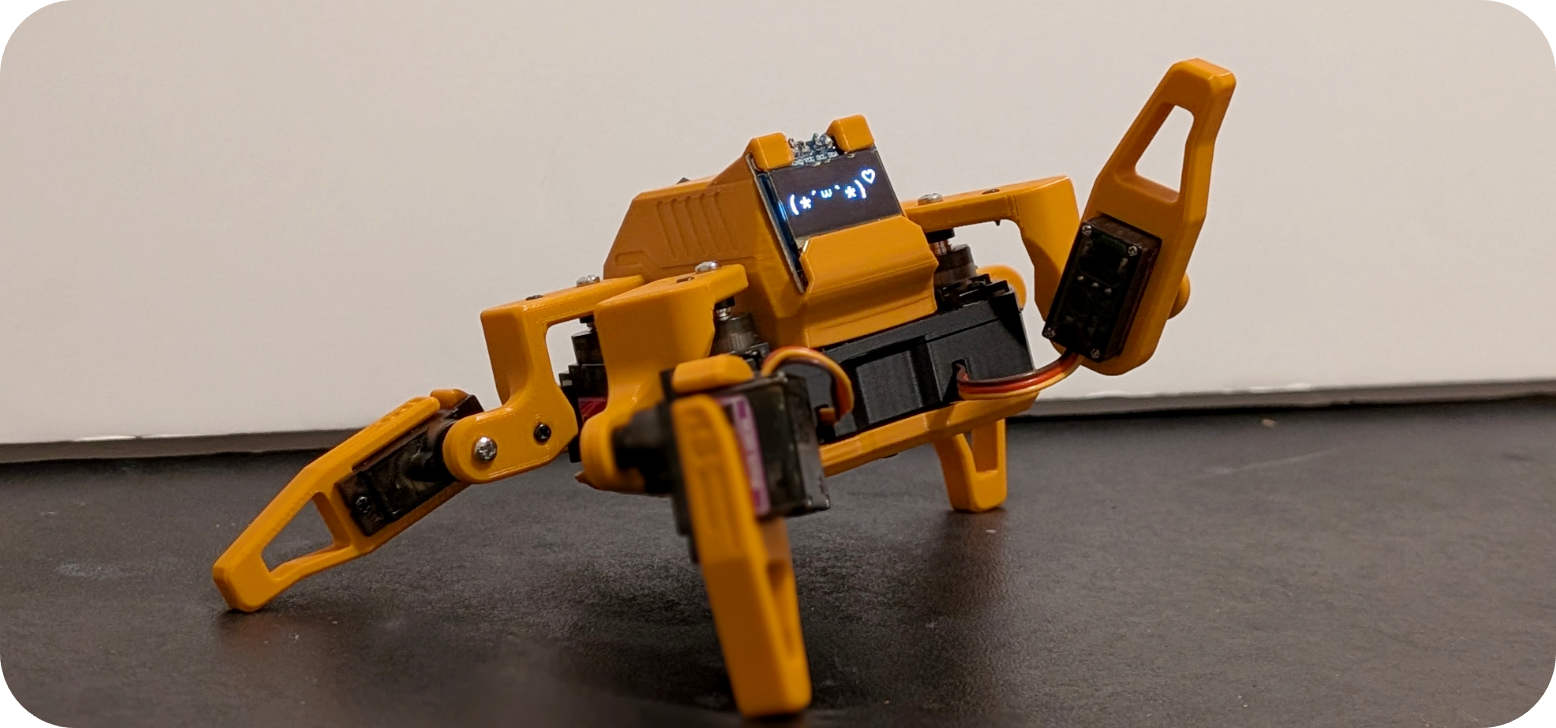
Sesame is a small walking quadruped built around an ESP32. Eight 180-degree MG90S servos give two joints per leg, a 128x64 OLED acts as a face, and the firmware serves a Wi-Fi control page, a JSON API and a serial command line. The frame is eleven PLA prints. The README aims it at makers with basic soldering skills, a 3D printer and some Arduino IDE experience. [1] [4] [8]
Is this for you?
- Use cases
- Programming poses and animations
- Local-network control through the JSON API, including voice-assistant companion projects
- Known limitations
- Four controller routes (S2 Mini, Distro Board V3.1, legacy V2, legacy V1) need different wiring and firmware pin blocks
- Upstream reports V2 battery brownouts and original V3 power/USB defects fixed in V3.1
- Battery guidance differs between the build guide and the BOM
- Version labels for top covers, STLs and CAD do not line up one-to-one
- No physical build, calibration or walking test performed for this profile
Source-review findings; no hardware tests.
What you need
- Host computer
A computer running Arduino IDE for flashing; a phone or browser for the Wi-Fi control page.
- Dependencies
- Arduino IDE 2.0 or newer
- Espressif ESP32 board support v2.0.0 or newer
- ESP32Servo v3.0.9
- Adafruit SSD1306
- Adafruit GFX Library
- Tools
- Soldering iron, leaded solder, flux and wick
- Flush cutters
- Precision screwdriver set
- PLA-capable 3D printer
- Skills
- Basic soldering
- 3D printing in PLA
- Flashing ESP32 boards with Arduino IDE
Hardware & parts
Upstream bill of materials [1]
- Hardware configuration
Quadruped with two servo joints per leg and an OLED face.
- Actuators
- 8 x 180-degree MG90S all-metal micro servos (BOM suggests buying 10)
- Controller
Lolin ESP32-S2 Mini on protoboard (recommended DIY) or Sesame Distro Board V3.1 (ESP32-S3); Distro Board V2 and V1/ESP32-DevKitC-32E are legacy.
- Power
At least 5 V / 3 A at the rails via USB-C PD (tethered) or battery through switch and buck converter; Bambu Lab 14500 7.4 V 800 mAh pack recommended.
- Degrees of freedom
8
README states 8 servos, 2 per leg, roughly 8 degrees of freedom.
- Replacement parts
BOM recommends buying 10 servos for 8 positions to keep spares; servo horns included with servos.
Assembly & first use
Open the upstream getting-started guide [1] · Project documentation [1] [6]
- Choose a controller route (S2 Mini hand-wired build is the recommended DIY path)
- Source the core BOM plus the wiring option for that route, buying 180-degree MG90S servos
- Print the eleven PLA parts, including the current internal frame for the Bambu Lab 14500 pack
- Build the harness, flash the motor tester and calibrate with hip joints removed
- Attach joints in REST/STAND poses, close the shell and flash the main firmware with the matching pin block
Editorial reading order across the upstream guides; not a reproduced build.
- Assembly
Five-phase guide: gather parts, pre-build harness, pre-assemble joints and top cover, mount motors and electronics, calibrate and close.
- Calibration
Motor tester or pre-flashed portal with joints removed, then hip joints fitted parallel in REST and checked at 45 degrees in STAND before screwing down.
- Assembly time
Build guide estimates five phases of 1-2 sessions each; no hour figure.
Cost
| Version | Price |
|---|---|
| Upstream-stated hardware component range for one Sesame build | USD 50.00 [1] [10] Parts estimate |
Not stated; BOM links are representative US Amazon searches · Checked 2026-10-05
| Included | Hardware components as summarized upstream (servos, controller, display, power and wiring parts); exact composition not itemized with prices |
|---|---|
| Not included | 3D printer access and filament (listed as separate requirements); Soldering and hand tools; Battery charger unless counted by upstream (not established); Shipping and taxes; Assembly work |
| Stock | Supplier stock not checked; BOM notes prices change frequently. |
| Delivery and tax | Not established; no delivered total. |
Price details
Upstream README and maintainer page give this rounded range for hardware components; the variant, supplier set and date basis are not stated. Not a fresh quote.
Not stated; BOM links are representative US Amazon searches · Checked 2026-10-05 · Quantity 1
Printed parts, tools and a 5 V / 3 A power source must be reconciled for the chosen board route.
Cost and licensing scope
The README and the maintainer's page both give about USD 50–60 in hardware components. A 3D printer is listed as a separate requirement. That range is not itemized, and it does not name a controller route or a date. The BOM links point to representative Amazon searches and note that prices change often. Whether it covers tools, filament, shipping or taxes is not established, so budget for those separately and treat the range as a rough parts figure, not a delivered quote. [1] [4] [10]
The repository has one license file, Apache License 2.0, at its root, and the maintainer describes Sesame as Apache 2.0. The pinned archive contains Fusion 360 and STEP sources, STLs, Distro Board Gerbers (EasyEDA sources for V2 and V3.1), firmware and Sesame Studio. Purchased modules and external Arduino libraries keep their own terms. The companion app, simulator and ML tools are separate projects and were not reviewed here. [1] [3] [9] [10]
No part of this profile comes from a physical build, flashing session or walking test. Dimensions, battery runtime and gait performance remain unverified.
3D preview
Preview not available yet. Design-source links are available. A configuration-matched assembly and its file-level reuse scope have not yet been reviewed for a hosted preview.
Model sources
Design-source links are available. A configuration-matched assembly and its file-level reuse scope have not yet been reviewed for a hosted preview.
Project notes
Four boards, four wiring and firmware paths
The main decision is the controller, because wiring, power and firmware settings all follow from it:
- Lolin ESP32-S2 Mini on a protoboard. Recommended for DIY builds. It uses the core BOM plus wiring option A (protoboard, headers and a buck converter rated for a stable 5 V / 3 A output), and the rails need at least 5 V at 3 A from USB-C PD or a battery. [1] [4] [5]
- Sesame Distro Board V3.1 (ESP32-S3). The current board, with a Bambu Lab battery connector. Built from scratch, its SMD parts need advanced soldering or a PCB assembly service. Build kits include an assembled, pre-flashed Distro Board, described upstream as V3 or earlier V2, so confirm the revision with the supplier before relying on the V3.1 fixes or choosing a power route. The PCB notes say its 12 V USB-C PD negotiation is "slightly untested". The original V3 had USB interference and a reversed battery connector, both fixed in V3.1. [5]
- Distro Board V2. Legacy; battery brownouts restrict it to USB power unless a separate buck converter is soldered onto the power line, as the PCB notes describe. [4] [5]
- Distro Board V1 with an ESP32-DevKitC-32E. Legacy; cannot run on tethered USB-C power. [4]
The firmware guide asks you to select the matching board in Arduino IDE and uncomment the matching servo-pin block. It also pins ESP32Servo to v3.0.9 because newer releases have a known multi-channel issue. Buying servos that are not the 180-degree MG90S variant is flagged as a build-breaking mistake. [4] [7]
Reconcile the guides before printing
Several upstream documents disagree in small but practical ways. The build guide's parts checklist mentions two 14500 cells in an AAA holder, while the BOM recommends a Bambu Lab 14500 7.4 V 800 mAh pack and a reprinted internal frame. The printing guide recommends "Enclosed v91", the top-cover notes describe "Enclosed v100", and the pinned STL is named v117. The CAD sources are labelled v122 while the STLs are v117 and v121; we did not compare their geometry. The build guide also links a motor-testing page under hardware/, but the pinned archive has it at the top-level motor-testing/README.md. [4] [6] [8] [9]
Calibration happens with every joint removed so each motor shaft spins freely, using the motor tester on DIY and V1 builds or the pre-flashed portal on kit boards. The build guide then fits each hip at 45 degrees while the motors hold STAND, checks that REST brings it parallel to the body, and only then fastens it; leg joints follow the same check for collisions. [6]
What we checked
Source research only; no physical build, flashing, calibration or walking test was performed. No affiliate links added.
Not yet established
- Requirements: operating system
Updates
- Upstream last updated
- Sep 13, 2026 [2]
- Latest release
- Not established
- Profile updated
- Oct 25, 2026
- Sources last checked
- Oct 5, 2026
- Next review
- Nov 5, 2026
- Reviewed revision
- d106cbc8e158c982f408db421134f23273c5f51f (commit snapshot; no published stable release found) · combined hardware and software repository
Source files and licenses
Mechanical sources, PCB fabrication files, firmware and guides are in one pinned repository under a root Apache-2.0 license; physical build and performance remain untested.
| Layer | Availability / license |
|---|---|
| mechanical design | available · Apache-2.0 Pinned archive contains Fusion 360 (.f3z) and STEP sources plus STL print files. Root Apache-2.0 is the only license file found; the maintainer page states the project is Apache 2.0. No separate hardware license file. [1] [3] [8] [9] |
| electronics | available · Apache-2.0 Distro Board V3.1, V2 and V1 Gerbers; V3.1 and V2 EasyEDA source JSON, BOM and pick-and-place files. Purchased modules (ESP32 boards, OLED, servos) are not covered by the repository license. [3] [5] [9] |
| firmware | available · Apache-2.0 Arduino sketch, headers and motor-tester firmware. External Arduino libraries keep their own terms. [3] [7] [9] |
| software | available · Apache-2.0 Sesame Studio Python tool is in the repository; companion app, simulator and ML tools are separate projects not reviewed here. [1] [3] [9] |
| documentation | available · Apache-2.0 Build, wiring, printing and firmware guides in the repository; root license applies as declared. [1] [3] [6] |
The reviewed firmware uses scripted poses and sequences; no trained policy is part of this configuration. Third-party ML tools are separate.
No dataset is part of the reviewed build configuration.
References
Each source links to the exact revision we read. “Used for” shows where this page relies on it.
- S001 Sesame Robot README
Project scope, $50-60 hardware statement, eight-servo quadruped features, controller options and software components.Revision, date & where cited
Dorian Todd / sesame-robot contributors · github.com · revision
d106cbc· README.md at d106cbc8 · Accessed Oct 5, 2026
Used for: Overview, Is this for you?, What you need, Hardware & parts and 4 more - S002 dorianborian/sesame-robot: commit d106cbc
Selected commit, commit date, archive checksum and dated repository popularity counts.Revision, date & where cited
Dorian Todd / sesame-robot contributors · github.com · ; default-branch snapshot, no stable release in first 100 · Accessed Oct 5, 2026
Used for: What we checked - S003 Repository license (Apache License 2.0)
Root Apache License 2.0 text; appendix copyright placeholder not filled in.Revision, date & where cited
Dorian Todd / sesame-robot contributors · github.com · revision
d106cbc· Accessed Oct 5, 2026
Used for: Cost, Source files and licenses - S004 Bill of materials
Component quantities, wiring options A-C, power notes, fasteners and tools.Revision, date & where cited
Dorian Todd / sesame-robot contributors · github.com · revision
d106cbc· Accessed Oct 5, 2026
Used for: Overview, Is this for you?, What you need, Hardware & parts and 4 more - S005 PCB and Distro Board notes
Distro Board V3.1/V2/V1 status, V3 defects and fixes, fabrication files and ordering notes.Revision, date & where cited
Dorian Todd / sesame-robot contributors · github.com · revision
d106cbc· Accessed Oct 5, 2026
Used for: Is this for you?, Hardware & parts, Four boards, four wiring and firmware paths, Source files and licenses - S006 Build guide
Five build phases, battery note, calibration and joint attachment procedure.Revision, date & where cited
Dorian Todd / sesame-robot contributors · github.com · revision
d106cbc· Accessed Oct 5, 2026
Used for: Is this for you?, What you need, Assembly & first use, Reconcile the guides before printing and 1 more - S007 Firmware documentation
Arduino IDE prerequisites, ESP32Servo version pin, board selection and pin-configuration steps.Revision, date & where cited
Dorian Todd / sesame-robot contributors · github.com · revision
d106cbc· Accessed Oct 5, 2026
Used for: Is this for you?, What you need, Assembly & first use, Four boards, four wiring and firmware paths and 1 more - S008 Printing guide and top-cover notes
PLA settings, eleven-part print table and top-cover version labels.Revision, date & where cited
Dorian Todd / sesame-robot contributors · github.com · revision
d106cbc· hardware/printing/README.md; hardware/printing/stl/top-covers/README.md · Accessed Oct 5, 2026
Used for: Overview, Is this for you?, Assembly & first use, Reconcile the guides before printing and 1 more - S009 Pinned repository file inventory
Presence and sizes of CAD, STL, PCB, firmware and documentation files.Revision, date & where cited
Dorian Todd / sesame-robot contributors · github.com · revision
d106cbc· archive member list (selected paths); not a completeness or geometry test · Accessed Oct 5, 2026
Used for: Is this for you?, Cost, Reconcile the guides before printing, Source files and licenses - S010 Sesame Robot Project page (maintainer site)
Maintainer description of parts cost, license intent and project history.Revision, date & where cited
Dorian Todd · doriantodd.com · Page snapshot sha256 69da39c35483ba57 · Accessed Oct 5, 2026
Used for: Cost - S011 Upstream image and reuse attribution
Media-only review: Upstream photograph of an assembled Sesame quadruped. Reuse basis: Apache-2.0; inspected LICENSE and the pinned file inventory for nearer notices. Original image unchanged; displayed responsively. This does not refresh technical or cost evidence.Revision, date & where cited
dorianborian and Sesame Robot contributors · github.com · Image SHA-256 bfa809de5c540f817722149cb77c57f99fcbda7bf37b8ba8d00f07acbb353d28; repository · Accessed Oct 25, 2026
Correction guidance · Discussion is not enabled · Profile format 0.7.0-draft.5
Change history
2026-10-05 — Initial source-researched profile from pinned commit d106cbc8 and maintainer page snapshot.
2026-10-25 — Added an attributed upstream image with linked reuse terms; technical evidence dates unchanged.