SimpleSliderHand
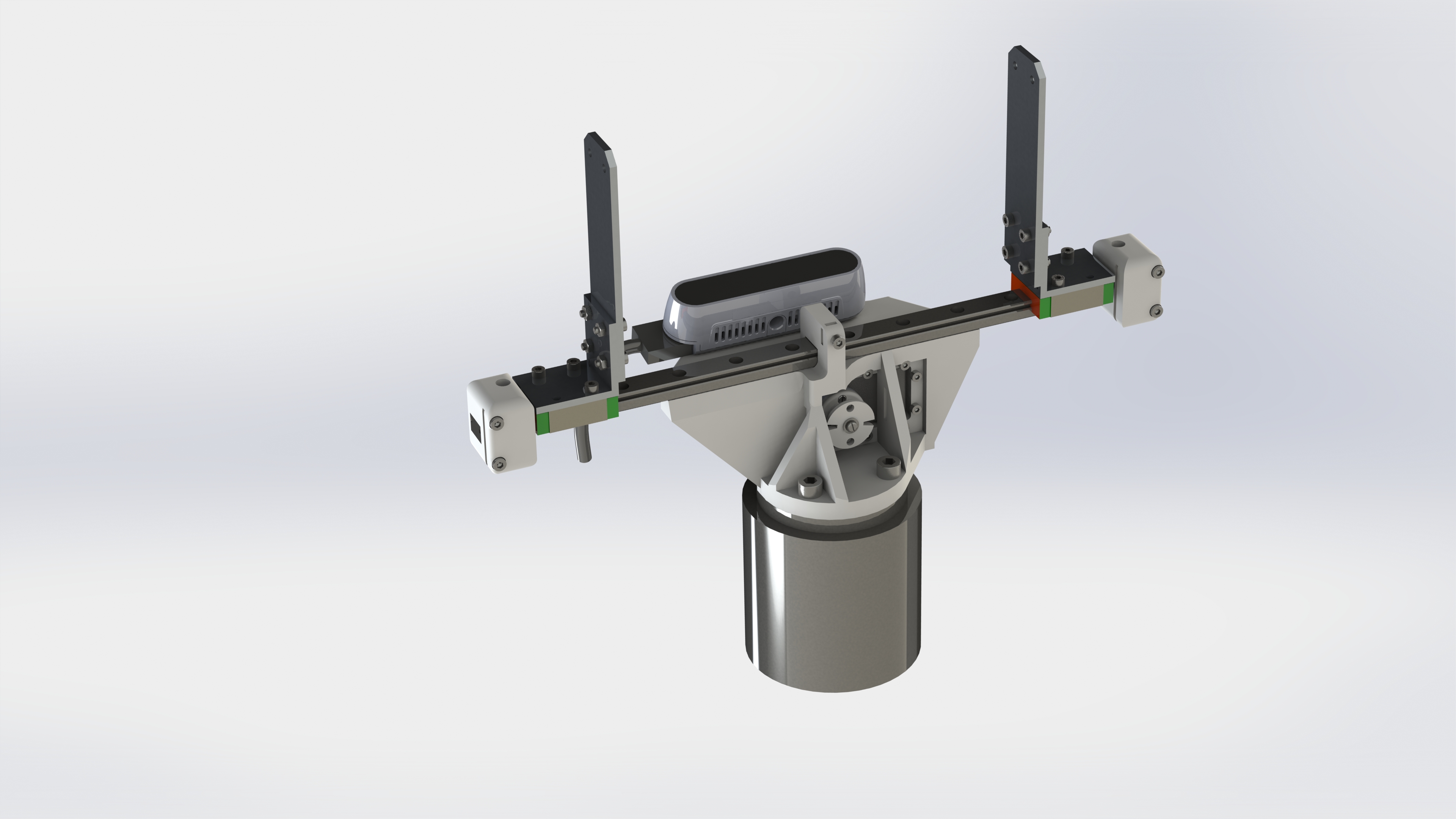
End effectorTendon-driven sliding jaws on a 12 mm rail, MX28T servo, OpenCM9 and EXP485. Optional capacitor board supports power-loss repositioning. [1] [2] [3]
Build & first use →Official website
- Cost
- No current cost or bill of materials established yet.
- Source rights
- Some licenses are unresolved. Review licenses
- Unknowns
- host computer, tools, operating system not fully established. Review gaps
Source researched · Not tested by us
Sources checked · Research details

Licenses & related hardware
- License
- GPL-3.0 · license not fully assessed for documentation · Details by part
Overview
SimpleSliderHand uses a Dynamixel MX28T and fishing-line tendons to move two sliding jaws along a 12 mm rail. It is a fabrication project for research or teaching, with documented Universal Robots mounting geometry and explicit limits on precision and repeated cycling. [3]
Is this for you?
- Known limitations
- Tendon tension, calibration and backlash require tuning. Upstream excludes sub-3 mm precision/torque-control use and warns against assuming thousands of cycles. Rail length is configurable; not equal to stroke.
- No hardware build or test performed.
Source-researched; no physical verification.
3D preview
SimpleSlider gripper base. The single GripperBase mesh supplied by the example URDF. It does not provide separately articulated fingers or a host-arm assembly.
The 3D preview loads after the page.
Drag to orbit · Scroll or pinch to zoom · Right-drag to pan. Use the view buttons for front, side and top views. The tree shows names supplied by the source; unnamed bodies remain labeled as such.
Download original URDF source bundle (ZIP) · File checksums and provenance
This model contains one geometric body.
Model sources
The preview uses the linked original design. Source grouping is retained where present; the caption identifies whether this is an assembly or one component.
Source, license and scale
Source: jaspereb / SimpleSliderHand contributors, revision 88de4cc8f111ced40420fea9c52a502499f0fe7f. Original and preview: GPL-3.0. Preview conversion by Open Source Robotics; source files unchanged inside the downloadable bundle. Preview coordinates are centered and rounded to six decimal places. URDF visual origins, mesh scales and joint transforms applied at zero joint positions, then metres converted to millimetres. No physical part tested.
Viewer: three-cad-viewer 5.0.7 (MIT license). Confirm scale and manufacturing settings before printing.
Hardware & parts
Assembly & first use
Project documentation [1] [2] [3] [4] [5]
- Assembly
Tendon tension, calibration and backlash require tuning. Upstream excludes sub-3 mm precision/torque-control use and warns against assuming thousands of cycles. Rail length is configurable; not equal to stroke.
Known prerequisites and unresolved assembly decisions; not a complete build instruction.
Cost
No current, complete configuration-specific build cost has been established for this profile.
Project notes
Parts and fabrication
The README directs builders to read BuildInstructions.pdf before starting. Its main parts are the servo, rail with two carts, OpenCM9 controller, EXP485 power board and high-strength fishing line. A 3D printer and a soldering iron for heat-set inserts are required. SolidWorks and STL files are inventoried in the pinned repository. No current delivered parts or complete integration cost is established here. [1] [3]
An optional capacitor board moves the servo back into the required rotation range when power is lost. Tendon tension and calibration need tuning; the upstream design still has backlash and is not recommended for positioning finer than 3 mm or torque control. Upstream reports hundreds of operations without issues but warns that the current fine-tendon design without bearings will not support cycle counts in the thousands. Neither statement is independently tested here. Rail length is configurable and must not be confused with usable jaw stroke. [3]
Mounting and control reconciliation
The README specifies four M6 fasteners on a 50 mm diameter mounting circle for Universal Robots arms. That is interface documentation, not a verified fit or safety assessment for every arm. [3]
The root README describes single-gripper firmware, but the software README discusses a Yale openHand configuration with four MX28AT servos. ROS documentation identifies a parallel_gripper package under ROS_Interface, while the root README gives another path and example package name. Reconcile the intended firmware, servo setup, package path and commands against the selected files before applying the instructions. These differences do not establish that the code cannot work. [3] [4] [5]
Available files
The root license is GPL-3.0. Mechanical designs and control documentation are available; their presence does not establish a complete matched control release or source rights for the purchased servo and controller. Preserve the applicable notices when selecting files. No hardware build or test was performed for this profile. [1] [2] [3]
What we checked
Source research only. No hardware assembly, performance testing, procurement or support qualification performed.
Not yet established
- Requirements: operating system, host computer, tools
- A step-by-step setup summary
Updates
- Upstream last updated
- Not established
- Latest release
- Not established
- Profile updated
- Oct 25, 2026
- Sources last checked
- Sep 30, 2026
- Next review
- Oct 30, 2026
- Reviewed revision
88de4cc
Source files and licenses
GPL-3.0 root license. Purchased motor/controller remain separate. Tendon tension, calibration and backlash require tuning. Upstream excludes sub-3 mm precision/torque-control use and warns against assuming thousands of cycles. Rail length is configurable; not equal to stroke.
| Layer | Availability / license |
|---|---|
| mechanical design | available · GPL-3.0 GPL-3.0 root license. Purchased motor/controller remain separate. Availability refers to the scoped files described here, not a complete configuration-matched manufacturing pack. [1] [2] [3] [4] [5] |
| electronics | not found · License not fully assessed A complete revision-matched source set for this tooling configuration was not established in the inspected documents. Standalone controls and purchased components require separate review; this is not a claim that no code or electronic files exist. [1] [2] [3] [4] [5] |
| firmware | not found · License not fully assessed A complete revision-matched source set for this tooling configuration was not established in the inspected documents. Standalone controls and purchased components require separate review; this is not a claim that no code or electronic files exist. [1] [2] [3] [4] [5] |
| software | not found · License not fully assessed A complete revision-matched source set for this tooling configuration was not established in the inspected documents. Standalone controls and purchased components require separate review; this is not a claim that no code or electronic files exist. [1] [2] [3] [4] [5] |
| documentation | available · License not fully assessed GPL-3.0 root license. Purchased motor/controller remain separate. Availability refers to the scoped files described here, not a complete configuration-matched manufacturing pack. [1] [2] [3] [4] [5] |
This profile scopes hardware tooling, without selecting a learned controller or training dataset.
References
Each source links to the exact revision we read. “Used for” shows where this page relies on it.
- S001 SimpleSliderHand pinned tree
Revision, date & where cited
github.com · revision
88de4cc· Accessed Sep 30, 2026
Used for: Is this for you?, Hardware & parts, Assembly & first use, Parts and fabrication and 2 more - S002 SimpleSliderHand / LICENSE
Revision, date & where cited
jaspereb · raw.githubusercontent.com · Accessed Sep 30, 2026
Used for: Is this for you?, Hardware & parts, Assembly & first use, Available files and 1 more - S003 SimpleSliderHand / README.md
Revision, date & where cited
jaspereb · raw.githubusercontent.com · Accessed Sep 30, 2026
Used for: Overview, Is this for you?, Hardware & parts, Assembly & first use and 4 more - S004 Software/README.md
Revision, date & where cited
jaspereb · raw.githubusercontent.com · Accessed Sep 30, 2026
Used for: Assembly & first use, Mounting and control reconciliation, Source files and licenses - S005 ROS_Interface/parallel_gripper/CMakeLists.txt
Revision, date & where cited
jaspereb · raw.githubusercontent.com · Accessed Sep 30, 2026
Used for: Assembly & first use, Mounting and control reconciliation, Source files and licenses - S006 Upstream image and reuse attribution
Media-only review: Upstream illustration of the Simple Slider Hand, not a photograph. Reuse basis: GPL-3.0; inspected LICENSE and the pinned file inventory for nearer notices. Original image unchanged; displayed responsively. This does not refresh technical or cost evidence.Revision, date & where cited
jaspereb and SimpleSliderHand contributors · github.com · revision
88de4cc· Image SHA-256 306e85c66856ba2cab60b7deb0a2283878649d60b0110b20184c75dfc3a9751f; repository · Accessed Oct 25, 2026
Correction guidance · Discussion is not enabled · Profile format 0.6.0-draft.1
Change history
2026-09-30 — Classified in the end-effector hierarchy with cited mechanism and platform evidence; build and rights limitations retained.
2026-10-25 — Added an attributed upstream image with linked reuse terms; technical evidence dates unchanged.