OpenQuadruped
Robot / hardware buildTwelve-servo printed quadruped prototype with CAD, PCB files and ROS control sources; calibration, gait refinement and build instructions remain incomplete. [1]
Build & first use →Official websiteBill of materials
- For
- Developers willing to complete and validate a prototype robot control stack [1]
- Cost
- No current cost yet. Upstream bill of materials [1] [11]
- Source rights
- Named licenses are documented by part. Review licenses
- Unknowns
- host computer, tools, operating system not fully established. Review gaps
Source researched · Not tested by us
Sources checked · Research details

Licenses & related hardware
Overview
OpenQuadruped is a twelve-servo printed quadruped for exploring leg inverse kinematics, body pose and gait generation. Its repository contains STEP/STL parts, PCB Gerber archives and ROS-related control sources. The selected README still lists joint calibration, gait refinement and right-leg inverse-kinematics validation as unfinished work, so this is a prototype-development starting point rather than a verified assembly-and-walk recipe. [1] [5]
Is this for you?
- Known limitations
- Assembly instructions incomplete and linked BOM unavailable through the checked route
- Calibration, gait refinement and right-leg IK validation unfinished in README
- Legacy custom plotting tool described as likely broken; pitch and roll not working
- Wiki describes an RL stage that the README still lists as unfinished
3D preview
OpenQuadruped simulation robot description by Adham Elarabawy. OpenQuadruped by Adham Elarabawy, credited as the original creator as the project license requires. Shown: the simulation robot description loaded by launch/sim.launch (spot.urdf.xacro with spot_macro.xacro at commit b0ab4fa, expanded without changes) at zero joint positions, with 24 visual meshes from urdf/stl/OpenQuadruped on 25 links and 12 revolute leg joints. The joint layout was ported from the spot_mini_mini description by Maurice Rahme; the meshes are OpenQuadruped parts, not the SpotMicro files in the same folder. Only the two chassis side plates are identical to a printable hardware part (scaled from millimetres to metres); the other meshes are combined visualization meshes that do not match single printable part files, and the battery is a simple box. The top, bottom and electronics covers are not shown as separate parts. Visual simulation geometry, not a verified build reference; no manufacturing clearance is claimed. Fit and motion are not verified.
Credit: OpenQuadruped was created by Adham Elarabawy. The repository LICENSE is the MIT License (Copyright (c) 2020 Adham Elarabawy) with an added clause: “In order to use any of the works or derivative works that this license covers, explicit & formal credit must be granted to the original creator (Adham Elarabawy).” This preview and the hosted files keep that credit and the full license text. The CC BY 3.0 SpotMicro meshes in the same folder are not used. No manufacturing clearance is claimed. License: MIT License with formal-credit clause · upstream notice.
The 3D preview loads after the page.
Drag to orbit · Scroll or pinch to zoom · Right-drag to pan. Use the view buttons for front, side and top views. The tree shows names supplied by the source; unnamed bodies remain labeled as such.
Download original URDF source bundle (ZIP) · File checksums and provenance
Separate bodies can be inspected in the model tree. Explode is a viewing aid, not an assembly sequence.
Model sources
The preview uses the linked original design. Source grouping is retained where present; the caption identifies whether this is an assembly or one component.
Source, license and scale
Source: Adham Elarabawy (original creator), revision b0ab4fa599f94460828bf3aa4514240ae917ed38. Original and preview: MIT with an added formal-credit clause (Copyright (c) 2020 Adham Elarabawy). Preview conversion by Open Source Robotics; source files unchanged inside the downloadable bundle. Preview coordinates are centered and rounded to six decimal places. URDF visual origins, mesh scales and joint transforms applied at zero joint positions, then metres converted to millimetres. No physical part tested.
Viewer: three-cad-viewer 5.0.7 (MIT license). Confirm scale and manufacturing settings before printing.
What you need
Hardware & parts
Upstream bill of materials [1] [11]
- Hardware configuration
Printed quadruped with three joints per leg.
- Actuators
- Twelve servos; exact matched part selection not verified
Linked BOM could not be retrieved; no substitute servo specification inferred.
- Controller
Wiki describes Jetson Nano high-level control and a Teensy low-level controller communicating through rosserial.
- Degrees of freedom
12
Assembly & first use
- Inspect the selected CAD and PCB artifacts
- Recover or reconstruct a matched BOM before ordering parts
- Reconcile the wiki architecture with implemented code and unfinished README tasks
- Complete calibration and validate the leg model before gait work
Editorial research sequence, not a tested build procedure.
Cost
No current, complete configuration-specific build cost has been established for this profile.
Project notes
Recover the parts configuration before ordering
The mechanical folder contains files for the body, covers and left/right leg assemblies. Its instructions are explicitly marked in progress. The README links a Google spreadsheet as the BOM, but the connected retrieval attempt returned 404. That establishes a gap in this review, not proof that the sheet has been deleted or the hardware is closed. A matched parts list and current complete cost remain unverified. [1] [5] [6] [11]
The wiki's wiring page allows configuration differences, including Raspberry Pi versus Jetson Nano and voltage-converter choices. It also warns that the pictured switch's ground connection serves its indicator light and must not be copied blindly to a different switch. Read that diagram as an integration reference for a selected configuration, not a universal wiring prescription. [8]
Architecture is not implementation status
The wiki describes a Jetson Nano producing foot-position targets and a Teensy converting them into joint angles and coordinated servo motion over rosserial. It separates static body-pose control from the gait-generation path. The networking notes describe laptop-to-Jetson access as a debugging convenience with latency, rather than a completed remote-control performance claim. [7] [9]
The architecture page also describes a reinforcement-learning stage, while the main README still leaves reinforcement learning unchecked. The README is similarly explicit that the older custom matplotlib visualization has not been ported to the new control library and is likely broken; it notes nonworking pitch and roll. Those descriptions should not be promoted into claims that every illustrated control path runs in the saved revision. [1] [7]
A useful next step is to establish a matched BOM, inspect the current code against that architecture, complete servo calibration and validate the leg model before tuning a gait. This is an editorial work sequence based on the recorded gaps. No firmware build, simulation or physical test was performed here. [1] [6] [7] [11]
Keep mesh attribution separate
The root license contains MIT text followed by an explicit, formal creator-credit requirement and a DMCA statement. The effect of that addition on reuse terms is unresolved in this review, so do not assume an unmodified MIT grant; obtain clarification before relying on that interpretation. Separately, the bundled simulation-mesh directory includes a separate notice crediting KDY0523's SpotMicro design under CC-BY-3.0. Preserve those terms when reusing that asset set. Presence of those meshes does not establish that the simulation exactly matches the modified mechanical build. This profile records the available artifacts and prototype limits without claiming a completed reproduction. [3] [5] [10]
What we checked
Source research only; no installation, physical build or performance test performed. No affiliate links added.
Not yet established
- Requirements: operating system, host computer, tools
Updates
- Upstream last updated
- Aug 23, 2024 [2]
- Latest release
- Not established
- Profile updated
- Oct 25, 2026
- Sources last checked
- Oct 1, 2026
- Next review
- Oct 31, 2026
- Reviewed revision
- b0ab4fa599f94460828bf3aa4514240ae917ed38 (commit snapshot; no published stable release found) · combined hardware and software repository
Source files and licenses
Available project sources support research coverage; complete build and commercial qualification remain separate.
| Layer | Availability / license |
|---|---|
| mechanical design | available · MIT text with additional attribution clause Root MIT text with appended explicit/formal creator-credit clause; effect on reuse terms unresolved; bundled third-party simulation meshes have separate CC-BY-3.0 attribution. Purchased components retain their own terms. [1] [3] [5] |
| electronics | available · MIT text with additional attribution clause Root MIT text with appended explicit/formal creator-credit clause; effect on reuse terms unresolved; bundled third-party simulation meshes have separate CC-BY-3.0 attribution. Purchased components retain their own terms. [1] [3] [5] |
| firmware | available · MIT text with additional attribution clause Embedded control sources described in repository/wiki; complete functioning firmware build not verified. [1] [3] [5] [7] |
| software | available · MIT text with additional attribution clause Root MIT text with appended explicit/formal creator-credit clause; effect on reuse terms unresolved; bundled third-party simulation meshes have separate CC-BY-3.0 attribution. Purchased components retain their own terms. [1] [3] [5] |
| documentation | available · MIT text with additional attribution clause Root text includes an additional creator-credit clause; wiki terms not separately established and instructions remain incomplete. [3] [6] |
This profile selects the prototype mechanical/control architecture, not the unfinished RL work or a training dataset.
References
Each source links to the exact revision we read. “Used for” shows where this page relies on it.
Project sources
- S001 adham-elarabawy/open-quadruped: README.md
Revision, date & where cited
github.com · revision
b0ab4fa· Accessed Oct 1, 2026
Used for: Overview, Is this for you?, What you need, Hardware & parts and 4 more - S002 adham-elarabawy/open-quadruped: commit b0ab4fa
- S003 adham-elarabawy/open-quadruped: LICENSE
Revision, date & where cited
github.com · revision
b0ab4fa· Accessed Oct 1, 2026
Used for: Keep mesh attribution separate, Source files and licenses - S004 adham-elarabawy/open-quadruped: files
Revision, date & where cited
github.com · revision
b0ab4fa· archive file inventory · Accessed Oct 1, 2026 - S005 Complete pinned artifact inventory
Revision, date & where cited
github.com · revision
b0ab4fa· Archive filenames, not proof of matching complete build · Accessed Oct 1, 2026
Used for: Overview, Assembly & first use, Recover the parts configuration before ordering, Keep mesh attribution separate and 1 more - S006 Printed-model instructions
Revision, date & where cited
github.com · revision
b0ab4fa· Pinned instructions marked in progress · Accessed Oct 1, 2026
Used for: Is this for you?, Assembly & first use, Recover the parts configuration before ordering, Architecture is not implementation status and 1 more - S007 OpenQuadruped wiki: ROS-Node-Infrastructure.md
Revision, date & where cited
github.com · Accessed Oct 1, 2026
Used for: Is this for you?, What you need, Hardware & parts, Assembly & first use and 2 more - S008 OpenQuadruped wiki: Wiring-Diagram.md
Revision, date & where cited
github.com · Accessed Oct 1, 2026
Used for: Recover the parts configuration before ordering - S009 OpenQuadruped wiki: Networking-Setup.md
Revision, date & where cited
github.com · Accessed Oct 1, 2026
Used for: What you need, Architecture is not implementation status - S010 Bundled SpotMicro mesh attribution
Revision, date & where cited
github.com · revision
b0ab4fa· File-specific simulation mesh license · Accessed Oct 1, 2026
Used for: Keep mesh attribution separate - S011 Linked BOM retrieval result
Revision, date & where cited
adham-elarabawy / project contributors · docs.google.com · Connected Drive returned 404; accessibility gap, not proof of deletion · Accessed Oct 1, 2026
Used for: Is this for you?, Hardware & parts, Assembly & first use, Recover the parts configuration before ordering and 1 more - S016 Upstream image and reuse attribution
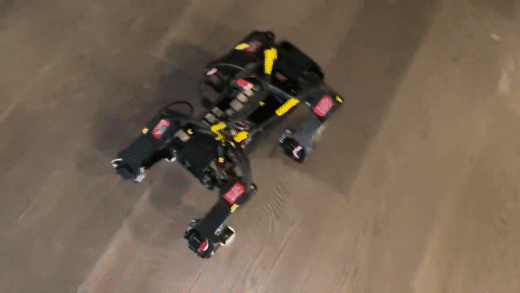
Media-only review: Still from an upstream demonstration: an OpenQuadruped build; the imported design files retain their own separate notices. Reuse basis: MIT; inspected LICENSE and the pinned file inventory for nearer notices. Still taken from the upstream animation; no other changes. This does not refresh technical or cost evidence.Revision, date & where cited
Adham Elarabawy and OpenQuadruped contributors · github.com · revision
b0ab4fa· Image SHA-256 62ddaa90f1bebd16bf48921064e5b02a2496ad5738016678da7aeec3e9561e3a; repository · Accessed Oct 25, 2026
Videos
- S012 OpenQuadruped: Inverse Kinematics Demo 1 (YouTube video)
Video from the project’s own channel (Adham Elarabawy), linked from the project’s own documentation. Not reviewed by us for accuracy.Revision, date & where cited
YouTube video Adham Elarabawy · youtube.com · Accessed Oct 4, 2026
- S013 Custom Quadruped: IK Model Visualization (YouTube video)
Video from the project’s own channel (Adham Elarabawy), linked from the project’s own documentation. Not reviewed by us for accuracy.Revision, date & where cited
YouTube video Adham Elarabawy · youtube.com · Accessed Oct 4, 2026
- S014 OpenQuadruped: Inverse Kinematics Demo 0 (YouTube video)
Video from the project’s own channel (Adham Elarabawy), linked from the project’s own documentation. Not reviewed by us for accuracy.Revision, date & where cited
YouTube video Adham Elarabawy · youtube.com · Accessed Oct 4, 2026
- S015 Adham Elarabawy (YouTube channel)
The project’s own YouTube channel, found by searching YouTube and checked against the channel page. Not reviewed by us for accuracy.Revision, date & where cited
YouTube channel Adham Elarabawy · youtube.com · Accessed Oct 4, 2026
Correction guidance · Discussion is not enabled · Profile format 0.6.0-draft.1
Change history
2026-10-04 — Added 4 YouTube reference(s) (S012, S013, S014, S015): official channel or videos linked from the pinned upstream sources. Existing claims, source-check dates and evidence are unchanged.
2026-10-25 — Added an attributed upstream image with linked reuse terms; technical evidence dates unchanged.